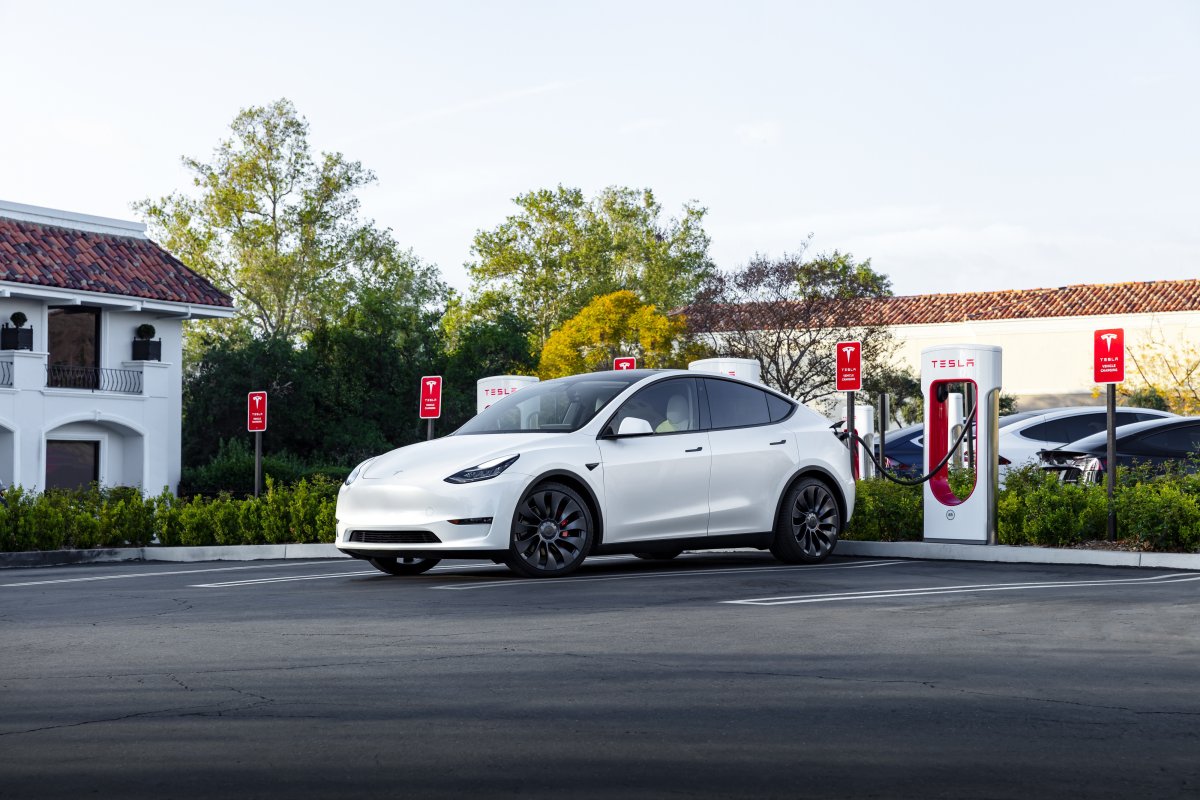
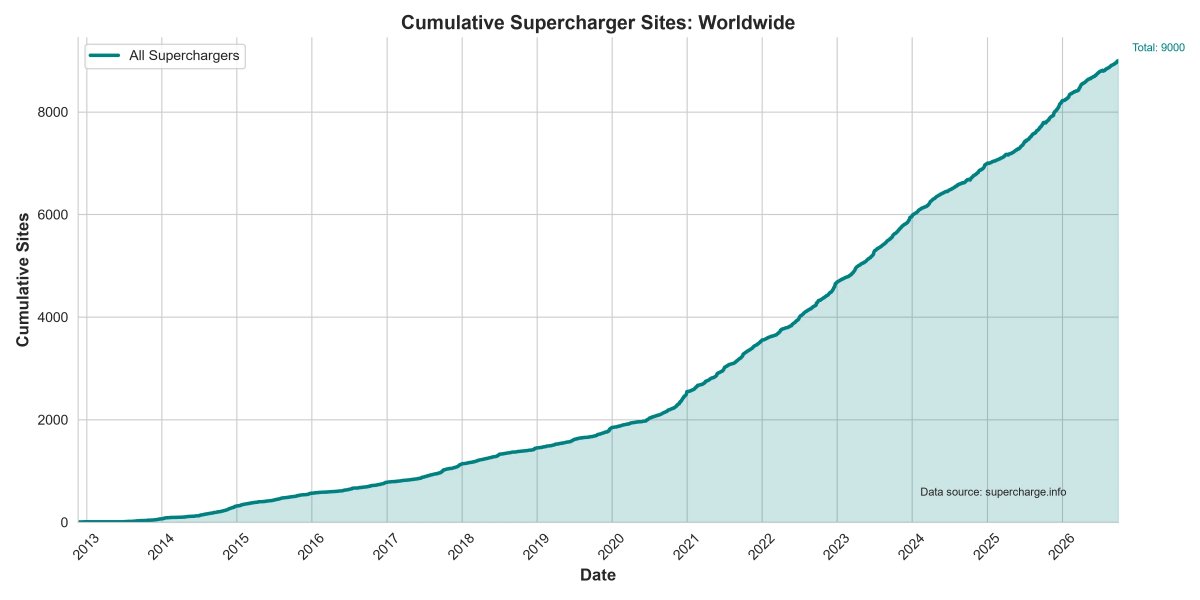
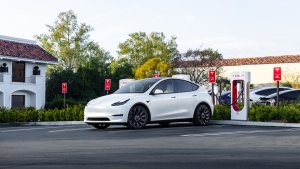
Tesla’s Supercharger network has passed 9,000 locations and 85,000 stalls worldwide. According to data from supercharge.info, there are now 9,000 open and active Supercharger locations with over 85,000 stalls. Tesla’s Director of Charging, Max de Zegher, replied to a breakdown from supercharge.info’s John Baker, noting, “Your numbers are very close to ours.”
The milestone comes about six months after Tesla hit 80,000 Supercharger stalls in April, so it has added roughly 5,000 more since.
Supercharger Growth Keeps Accelerating
supercharge.info’s charts show how much the pace has picked up. The network was around 2,500 sites and 23,000 stalls at the start of 2021. It has added roughly 6,500 sites and over 60,000 stalls since, and the lines get steeper each year.
@superchargeinfo / X
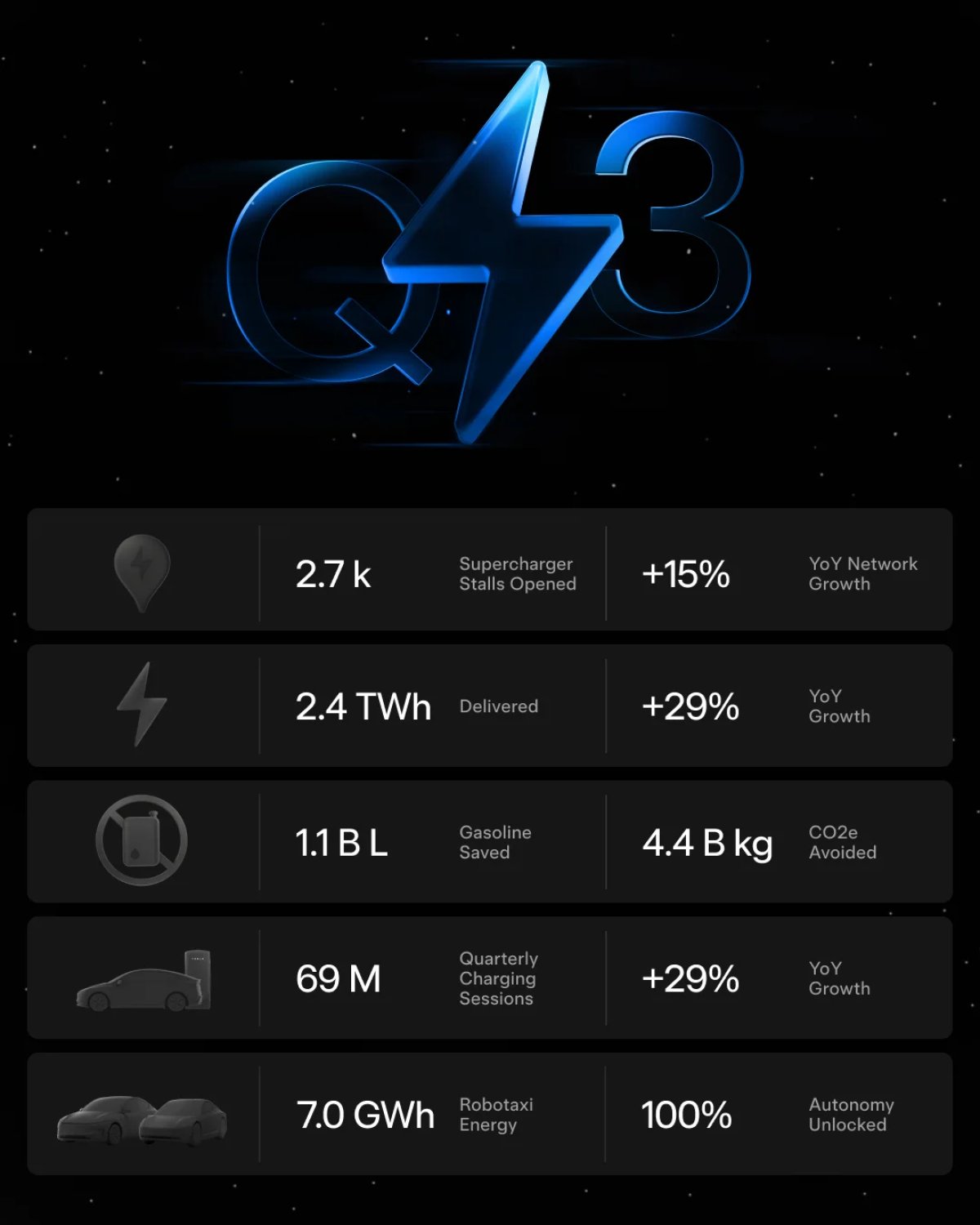
Tesla’s Q3 numbers fit that trend. It opened about 2,700 stalls in the quarter, up 15% year over year. Superchargers also delivered 2.4 TWh of energy between July and September, up 29% from a year ago.
Not a Tesla App
Baker’s breakdown shows 8,896 of the 9,002 open sites (98.8%) are Tesla’s. The other 106 (1.2%) come from the Supercharger for Business program, which lets businesses buy and brand Tesla-managed Superchargers. Businesses get to keep all the revenue from these white label Superchargers — minus a service fee charged by Tesla — and more and more companies are signing on.
By stalls, 84,427 (99.3%) are Tesla’s and 628 (0.7%) are Superchargers for Business. 5,622 Supercharger sites (62.5%) support other EVs, making up 61,071 stalls (71.8%).
Where Most Superchargers Are
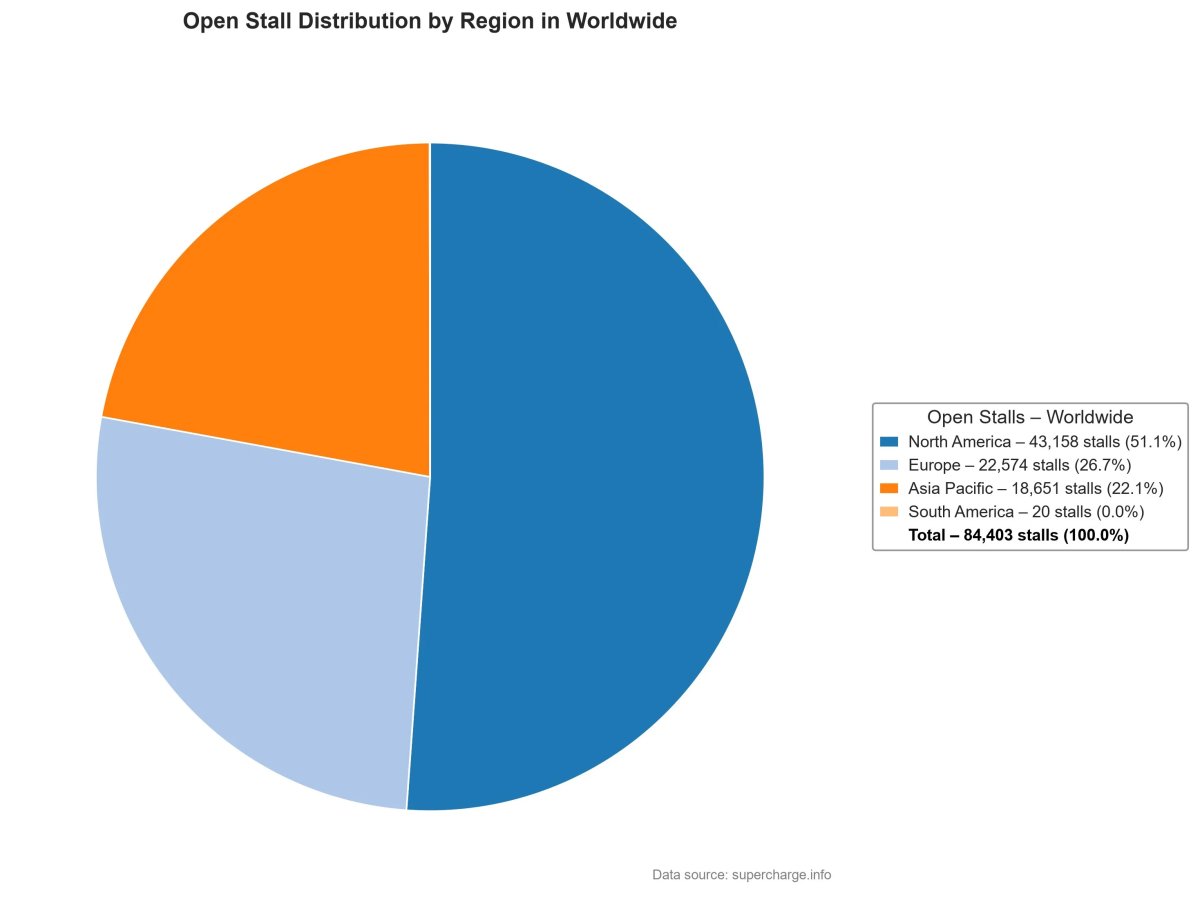
North America is home to more than half of Tesla’s Supercharger network, at 43,158 open stalls (51.1%), followed by Europe at 22,574 (26.7%), and Asia Pacific at 18,651 (22.1%). South America has just 20. supercharge.info’s map shows dense clusters across the U.S., Europe, and China, with 365 known sites currently under construction and 1,412 more planned worldwide.
@superchargeinfo / X
How Tesla Is Building Faster
Tesla’s evolving Supercharger deployment methods are a big reason the growth keeps speeding up. Last month, it debuted its Accordion Supercharger, which makes it easier to deploy stalls in trickier locations. Tesla has also been moving toward pre-fabricated posts it can drop in and wire up, plus folding Superchargers that install even quicker. Together, all of these deployment strategies are helping expand the world’s largest DC fast-charging infrastructure.
Tesla also introduced an Emergency Drive Away feature last week that lets drivers break away from a stall in an emergency, though it’s limited to U.S. Superchargers for now.
At roughly 2,500 to 2,700 new stalls per quarter, Tesla should hit the 90,000-stall mark around next spring.
Elon Musk is dropping “AI” from his AI businesses. After posting “No more AI” on X and saying SI is better, he confirmed that SpaceXAI will be renamed SpaceXSI, short for SpaceX Super Intelligence.
When someone asked on X whether SpaceXAI could become SpaceXSI, Musk replied, “Yes, we will make that change.” He also said, “SpaceX is a super intelligence company.” If the change goes through, it will be SpaceXAI’s second name change this year since SpaceX acquired xAI.
When another X user argued that it doesn’t make much sense to call the tech “artificial” when AI is building itself through recursive self-improvement, Musk added that humans are still involved in building these systems, but fewer as SI gets better at improving itself. Musk didn’t give a timeline for the rename — all of the official accounts and domains remain “SpaceXAI” at the time of writing.
Where the AI to SI Shift Is Coming From
The timing lines up with a push in Washington. President Trump signed an executive order last week directing executive-branch agencies to use “Super Intelligence” and “SI” instead of “Artificial Intelligence” and “AI” in official materials. That same day, Musk corrected himself mid-sentence after Trump left the White House meeting with tech executives, and Trump thanked him for using the new term.
SpaceXAI’s Naming History
It started as xAI, an independent AI startup created by Musk. After the SpaceX acquisition, Musk dissolved xAI as a standalone company and turned it into SpaceXAI, a division of its new parent.
Not a Tesla App
That rename came with a new logo unveiled earlier this summer that merged the xAI and SpaceX designs. It remains to be seen how the logo will change once the SpaceXSI name takes effect.
What It Means for Tesla
Tesla owns a piece of SpaceXAI through its stock in SpaceX, after converting its $2 billion xAI investment into a minority SpaceX stake. Musk also has Tesla’s own AI business, Tesla AI, and its branding could follow now that he’s moving away from the AI label. He hasn’t said whether it will, although we might need to start calling Tesla’s implementation of SpaceXAI’s Grok in its vehicles an “SI assistant” moving forward.
For now, SpaceXSI is a confirmed direction without a date. Another logo and handle update seems likely once it happens, since SpaceXAI went through the same process only a few months ago.