Following a major production refresh at Gigafactory Shanghai earlier this week, North American assembly lines are officially rolling out their own wave of updates. Buyers configuring a new Model 3 or Model Y in the U.S., Puerto Rico, and Mexico will find larger screens, faster acceleration, and subtle styling shifts live in the online configurator.
While North American Model 3 builds aren’t receiving Vehicle-to-Load (V2L) support just yet, Tesla has announced several other changes that streamline display hardware across the entire catalog while giving dual-motor configurations a noticeable boost in straight-line punch.
Model 3: 16” Screen and Quicker Acceleration
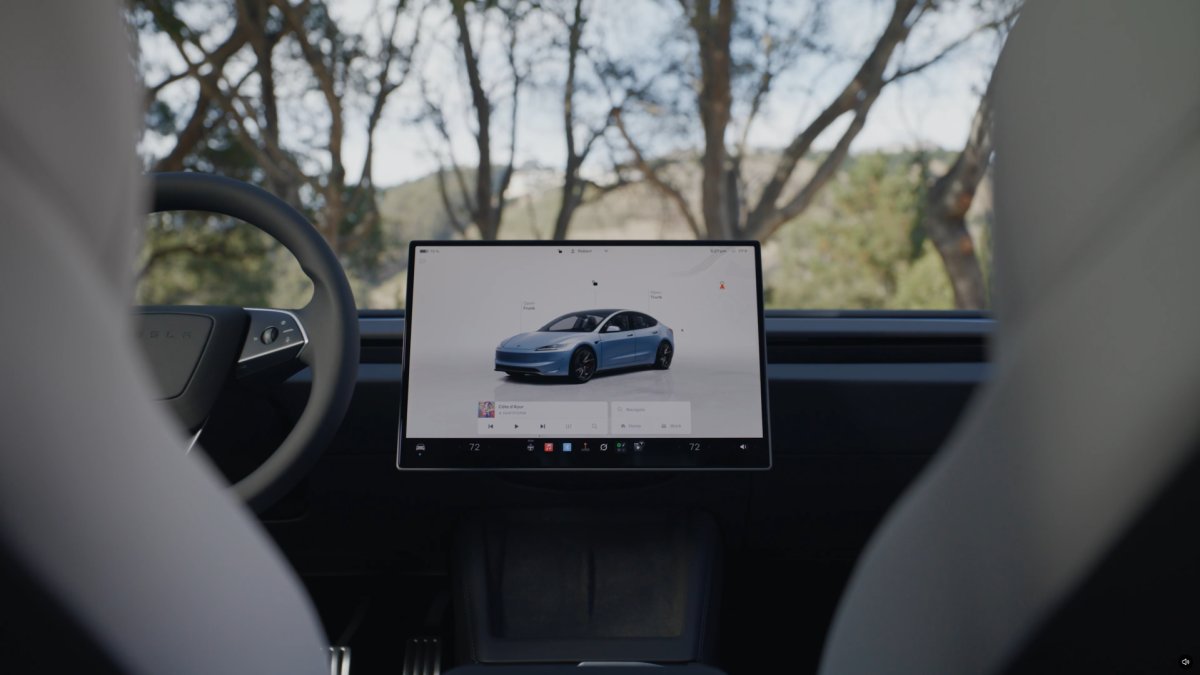
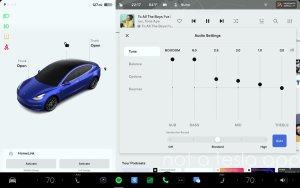
The most universal change lands on the center dashboard. Every Model 3 trim sold in North America now ships with a 16-inch center touchscreen, replacing the longstanding 15.4-inch panel.
Not a Tesla App
The slightly larger display matches the unit first introduced on the Model Y, offering higher pixel density and sharper resolution that makes the screen more readable. With this move, the older 15.4-inch screen is officially phased out across the passenger car lineup.
Spec
Old Display
New Display
Size
15.4”
16”
Resolution
1920×1200 (just over Full HD/1080P)
2560×1440 (QHD/1440P)
Screen Ratio
16:10
16:9
Display Width
13.06”
13.95”
Display Height
8.16”
7.84”
Screen Area
106.59 inches²
109.39 inches²
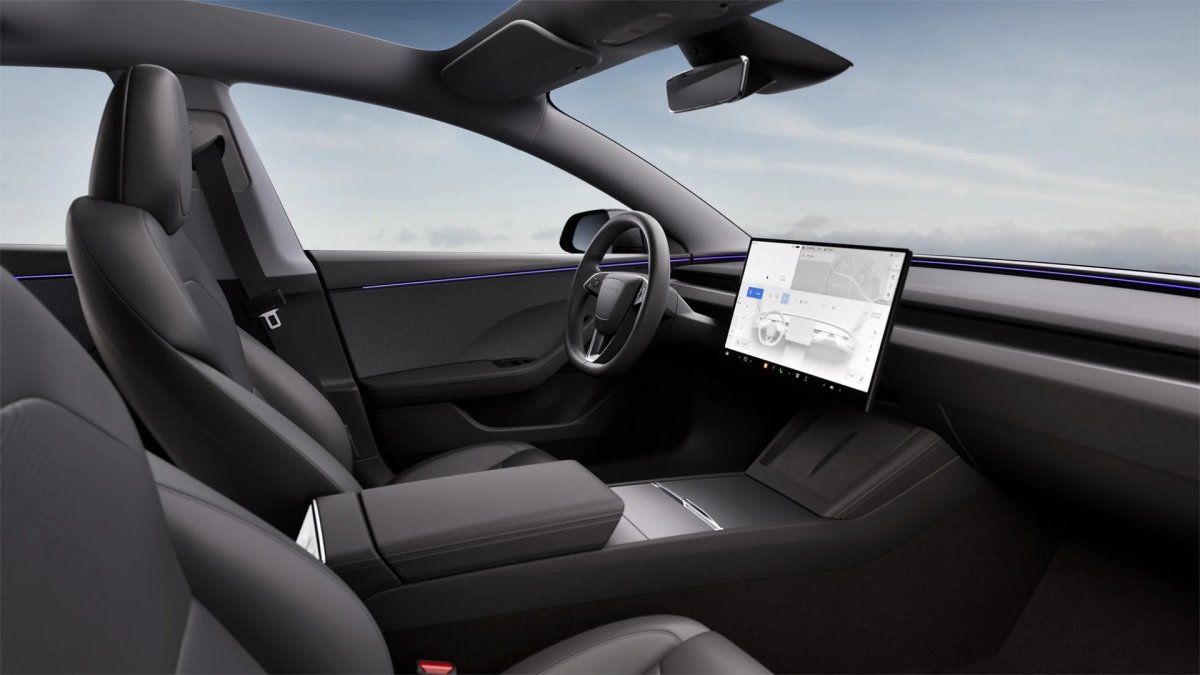
In addition to the larger screen, the long-requested all-black roof liner is now standard on the Model 3 Performance. Base and Premium trims still feature the light gray headliner, suggesting local factories are clearing existing inventory before rolling the dark fabric across lower-end trims.
Gray headliner on the Model 3 Premium vs. all-black headliner on the Model 3 Performance
Not a Tesla App
Rounding out the styling updates for the Model 3, the optional 19-inch Nova wheels now come in a darker gray finish rather than silver. Tesla is also rolling out a couple of performance upgrades, although they depend on the trim:
Model 3 Premium AWD: The dual-motor trim drops its 0-60 mph sprint time to 3.8 seconds, shaved down from 4.2 seconds before.
Model 3 Performance: Peak output climbs roughly 3% to 528 horsepower, and overall range gets a bump to 316 miles (a 2.3% increase over the previous 309-mile rating).
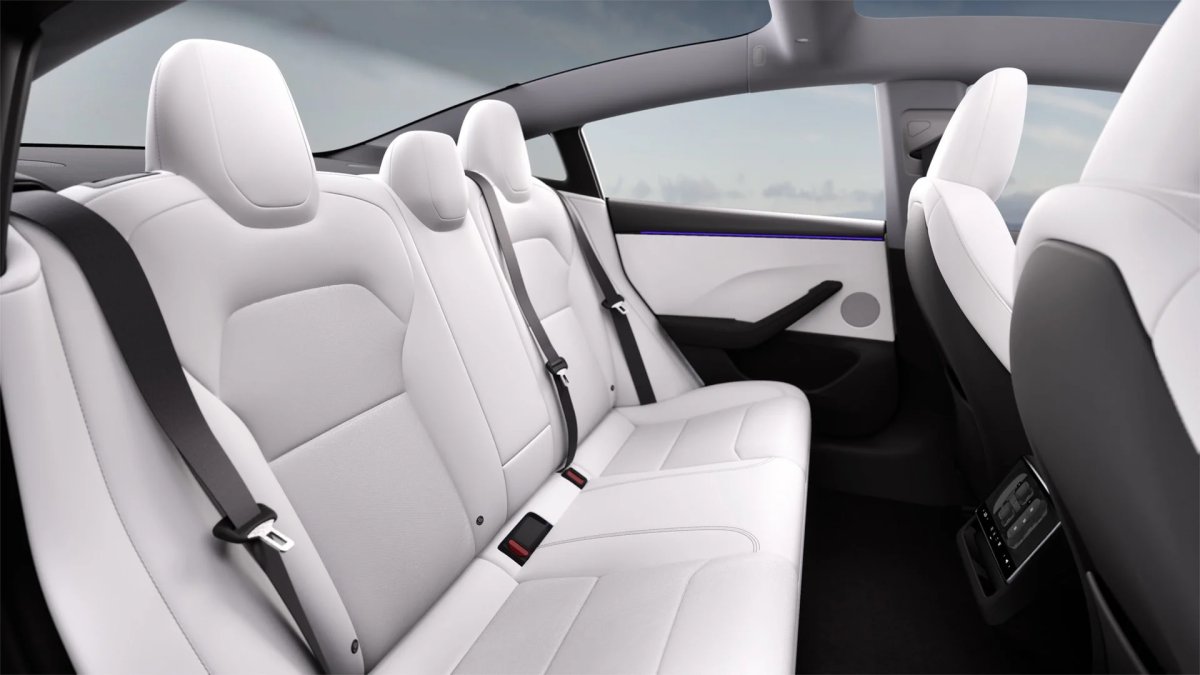
Unlike Tesla’s recent changes at Giga Shanghai, none of the Model 3 variants are getting the new “Zen Gray” interior. The classic “Black and White” color scheme is sticking around in North America for now, likely due to parts stock on hand.
Model Y: Faster 0-60 mph Times
The Model Y is also getting a welcome bump in speed. The Model Y Premium AWD now launches from 0 to 60 mph in 4.3 seconds, down from 4.6 seconds previously.
On the cabin side, the new Zen Gray interior option remains exclusive to the new three-row Model Y L for North American buyers. Standard Model Y configurations continue offering the choice between All Black and Black and White interiors.
Black and White vs. Zen Gray on the Model 3 Premium
Not a Tesla App
If you’ve been eyeing the stark, high-contrast look of the classic ultra-white cabin, now’s the time to place your order. With Asian and European factories already retiring white seats in favor of Zen Gray, it’s only a matter of time before Fremont and Giga Texas follow suit and discontinue the bright white option for good.
Tesla’s Full Self-Driving (Supervised) software has made huge strides this year with its European expansion and the launch of commercial driverless Robotaxis, but even dedicated users know the system still has a few persistent blind spots. Two of the most common complaints among drivers center around route selection and rough pavement: navigation taking confusing detours, and FSD plowing straight through tire-popping potholes.
Fortunately, fixes for both headaches are on the horizon. In an exchange on X, Shopify executive Farhan Thawar praised FSD v14.3.10 but noted that broken asphalt and stubborn navigation routing remain his biggest friction points.
Responding directly, Phil Duan, a principal software engineer on Tesla’s AI team, confirmed that “improvements on both are coming.”
Pothole Detection
Dodging road craters has been one of the most requested capabilities among the fleet, and Tesla has been promising it since 2019. More recently, Elon Musk noted pothole avoidance is officially coming soon, and Tesla has actively listed it as an upcoming improvement in release notes since FSD v14.3 earlier this spring.
Current builds occasionally display glimpses of this behavior. One tester running FSD v14.2.2.5 previously recorded their vehicle gently centering over cracked asphalt so the crater passed safely between the tires. However, it’s not clear whether the neural net recognized it as a pothole or simply reacted to an ambiguous road anomaly, and the behavior has been inconsistent across recent FSD versions.
Not a Tesla App
Once Tesla officially rolls out pothole avoidance, those rare maneuvers will turn into reliable, predictable driving habits. Rather than forcing drivers to manually disengage to protect their wheels and the occupants’ comfort, upcoming FSD models will detect broken surfaces in real time and steer smoothly around them.
FSD Navigation Improvements
Navigation logic is also receiving a massive overhaul. While FSD handles lane changes and turns well, drivers frequently complain about the overall route-picking logic and the system’s insistence on weird side-street detours instead of sticking to their regular commute.
Tesla is fixing this by teaching FSD to learn from your daily habits. By analyzing driver interventions, the system will use your manual lane choices and steering nudges as training feedback. If you consistently ignore a mapped detour to take a preferred highway exit or surface avenue, FSD will remember that preference on future trips rather than fighting the wheel. This capability will build upon the foundation Tesla recently laid with the new Preferred Routes feature.
VLoops11 / X
What’s more, that learning will extend all the way to your destination. Upcoming FSD builds will study your parking habits, noting whether you prefer reversing into home driveways, hugging garage walls to leave walking room, or parking slightly further from high curbs. Once trained, the car will try to mimic those preferences when parking autonomously.
Pothole avoidance was initially promised in the v14.3 release notes, but it remains to be seen whether these upgrades arrive in an imminent point release or debut with the upcoming FSD v15 architecture, which is expected to bring a major neural network upgrade to 10 billion parameters. Either way, teaching the car to dodge craters and remember your favorite streets will make daily autonomous commuting far smoother.