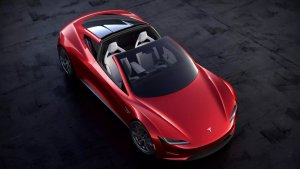
Tesla seems to have taken a significant step towards its long-awaited Robotaxi future with the launch of an autonomous transportation program at its Las Vegas Convention Center Loop (LVCCL) stations.
Ever since the launch of the Autopilot program in 2014, Tesla CEO, Elon Musk has promised a driverless future, in which Tesla vehicles would be able to join a so-called Robotaxi fleet and make money for their owners driving passengers around town.
Although we're still years always from this becoming a reality, we're now getting our first glimpse at the driverless feature in a limited fashion.
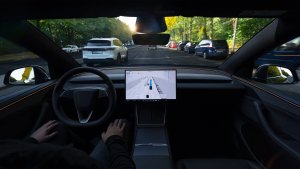
Tesla recently released FSD Beta update 10.11.1. The update has reportedly given the manufacturer enough confidence in their self-driving software to remove the safety driver from their Las Vegas Convention Center Loop (LVCCL) vehicles entirely and allow them to travel through the tunnels autonomously.
The Boring Company, another one of Elon Musk’s ventures, was created to construct fast-to-dig, low-cost transportation, utility, and freight tunnels in order to solve traffic and enable rapid point-to-point transportation within cities.
The Boring Company recently shared on their Twitter page: “Wednesday evening The Boring Company activated FSD 10.11.1 for its entire LVCC vehicle fleet and ran several test vehicles without drivers. Many conference attendees enjoyed a flawless journey.”
Tesla's Las Vegas Convention Center Loop
Electrek.com
The Las Vegas Convention Center Loop is the Boring Company’s first commercially operational loop service. It’s a three-station transport system with 1.7 miles of tunnels that officially debuted in June of 2021 and utilizes Tesla vehicles to shuttle passengers through the tunnels.
The Tesla vehicles used in the Loop were always able to autonomously drive through the tunnels, but The Boring Company still required safety drivers behind the seat, until now.
This is definitely an exciting new development in the timeline for autonomous driving, and an indication that the confidence of the company in their promised driverless future continues to increase with each new release of their full self-driving beta software.
Supply chain issues brought on by the pandemic have been particularly challenging for the automotive sector. A global chip shortage among an onslaught of supply chain obstacles have adversely affected the entire industry. Tesla's vertically integrated strategy proved to be very advantageous when facing these supply chain challenges.
Tesla's insistence on vertical integration used to be one of the main reasons the company struggled to become profitable and reach volume production. Now, it has allowed the company to scale rapidly while the broader automotive industry is down amidst a supply chain disaster.
The conventional automotive business model has traditionally concentrated on design and final assembly while largely outsourcing to suppliers. This strategy left them extremely vulnerable to supply chain turmoil.
In the past, automakers outsourced as much as possible and mainly focused on supply chain management. In the short term, this strategy reduced production costs but in the long term, legacy automakers lost the ability to adapt, innovate and advance technology.
Automotive manufacturing has typically relied on third party suppliers which has led to supply chain contingency and reliance on external companies. This business model has been successful for a long time due to the maturity of the internal combustion engine and a lack of need for innovation.
Tesla recognized the stagnant supply chain of the automotive industry and revolutionized it by adopting a vertically integrated strategy.
Tesla is a chain of startups
- Elon Musk
In recent years, Tesla has defied the conventional business model, reducing supply chain needs and reliance on other companies.
Tesla has vertically integrated many production steps, from battery production to electric powertrain production and self-driving software. According to Tesla CEO Elon Musk, Tesla is a "chain of startups."
This strategy allowed Tesla to avoid shortages of batteries, which have hindered legacy automakers from reaching volume production of electric cars. Before legacy automakers began investing in electric vehicle manufacturing, Tesla partnered with Panasonic to build its first gigafactory to produce batteries. Now, the gigafactory ensures a reliable supply of batteries.
Lucid Motors, a newer EV automaker, has also adopted a more vertically integrated business model. CEO Peter Rawlinson says that gives them a huge advantage in the modern EV technology race.
In an interview, Rawlinson stated, “The electric powertrain cannot be bought off the shelf at a world-class standard, it is not a commodity. This is a technology race and the market doesn’t see it yet."
Tesla's in-house software development is perhaps their biggest advantage over its competitors. As a Silicon Valley born company, Tesla has never outsourced their software. They have instead developed a proprietary self-driving software that is improved by collecting data from Tesla's network of over one million beta testers.
Ford CEO Jim Farley emphasized the company's need to move away from the “catalog engineering” business model at a conference earlier this year, saying "The most important thing is we vertically integrate."
Tesla is potentially going a step further to vertically integrate their supply chain. In light of the skyrocketing prices of lithium, Tesla may plan to get into the lithium mining and refining business. Tesla is considering mining some of its own raw materials for the same reasons that they developed their own batteries, produced their own electric motors and built their own computer chip and software for autonomous driving.
Tesla's pace of innovation and lead in the industry has become clear as the traditional business model of outsourcing components and software to cut production costs is quickly becoming outdated.
Tesla hacker and software engineer @greentheonly took to Twitter to say that “2022.20.7 seems to go into insane details to improve range predictions. Even tire pressure is taken into account (amongst many-many other extra variables just added).”
Greentheonly adds that the vehicle’s software will factor in the energy loss for phone charging and 12V accessories, battery heating/cooling, and air density.
The number of passengers inside the vehicle are now also taken into account, not only to account for the additional weight but to also account for the additional energy that the A/C has to use in order to maintain the cabin’s desired temperature.
Range anxiety is becoming a thing of the past, especially with EV owners who are very familiar with their vehicles. But for new owners, it’s still a thing.
These new improvements being implemented by Tesla in version 2022.20.7 are very much welcomed. Having the most accurate information to predict what percentage you’ll arrive at your destination is crucial, especially in the times when you won’t have charging readily accessible and for road trips.
It will be interesting to watch and see how these changes and considerations for range happen in real world scenarios. While these vast improvements will hopefully increase range transparency across Tesla’s entire fleet.
TeslaFi is a service that logs your drives and charging sessions so that you can later refer back to them. We highly recommend checking them out if you use your car for business trips and would like to keep track of reimbursements, if you like to see how much you spend on charging or if you just love statistics. View their about us page and see everything they have to offer!
DIMO is building a web3, user-owned network dedicated to supporting the next generation of mobility infrastructure. As a user, you can start today by accessing the best connected vehicle experience via the DIMO Mobile App. It works for nearly any vehicle and across any OEM; users are in control of their data and their DIMO wallet is a conduit to other apps and services, saving time and money. Learn more
Find out how to become a sponsor and have your site listed here.
Although we share official Tesla release notes, we are not affiliated with Tesla Motors. We are Tesla fans and supporters.