Tesla’s next-generation Roadster is finally here, and yes, it flies. At SpaceX’s rocket test site in McGregor, Texas, Tesla unveiled the long-delayed supercar with a pair of stunts: driving upside down and leaping over Tesla’s entire lineup with a mid-air flip.
Elon Musk called it the result of “a collaboration [between] the world’s best car company and the world’s best rocket company,” and told the crowd they needed to be there in person “to prove that it’s not AI or SI.” Here’s everything Tesla announced.
The Roadster Drove Upside Down, Then Flew
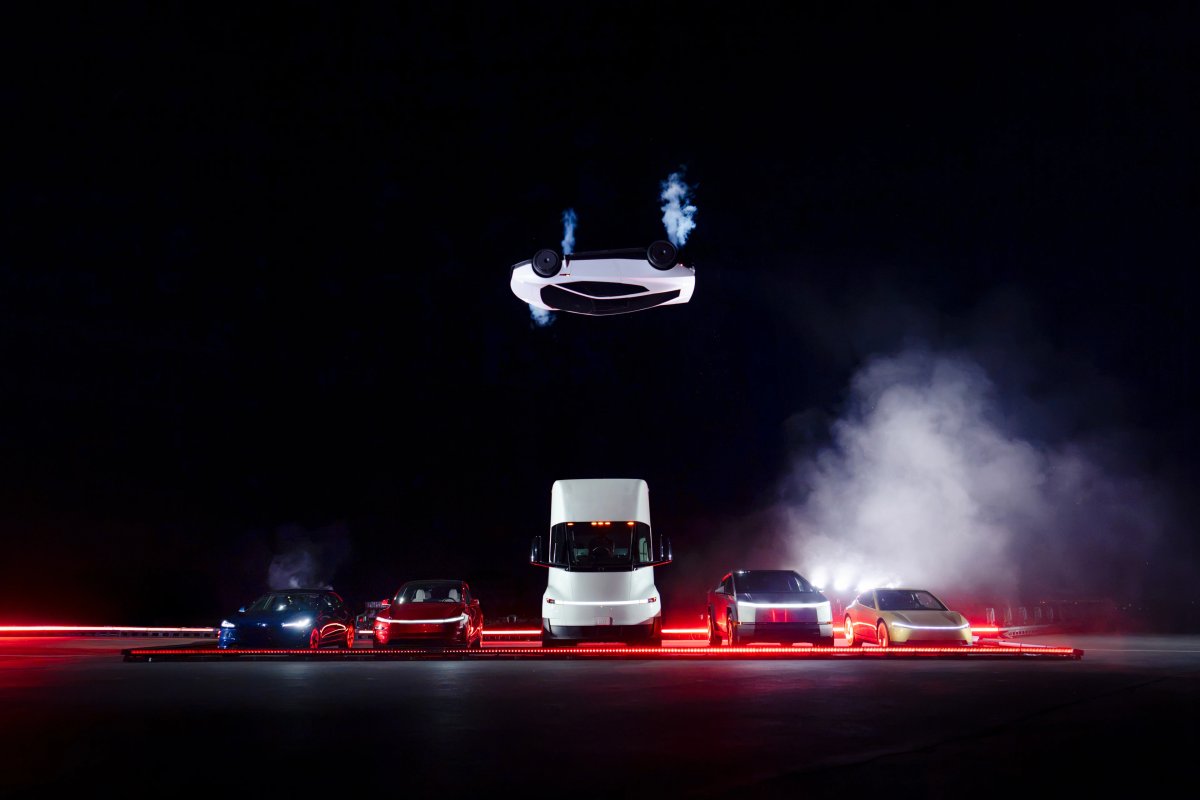
The first demo was exactly what we predicted Tesla’s “unforgettable” surprise would be. The Roadster drove up an inverted half-loop ramp, stuck to it upside down, then left the ramp fully flipped and parallel to the ground. Its compressed-air thrusters then rolled it upright, and it briefly hovered before touching down on the tarmac in a cloud of smoke.
“Well, it worked,” Musk said. He recalled fellow PayPal co-founder Peter Thiel’s famous quip about the future promising flying cars but delivering 140 characters instead, joking, “Well, not anymore.”
For the demo, the car was technically driving itself (FSD support confirmed?), which Musk said was “to make sure we don’t kill anyone.” Long term, though, he said the Roadster will be the only manually driven car Tesla makes.
Not a Tesla App
A Kickflip Over Tesla’s Entire Lineup
The second stunt went even bigger. The Roadster launched off the ground and over a row of Tesla vehicles, including the Model 3, Model Y, Cybertruck, Cybercab and even a Semi, flipping in the air before landing. Lars Moravy, Tesla’s VP of vehicle engineering, said, “Tony Hawk would be proud. We call that the kickflip.”
Musk said there will be such a car that someone can own, though he admitted he’s “not sure it’s necessarily legal in all jurisdictions.”
How It Works: Suction Fans and SpaceX Thrusters
The upside-down driving comes from a fan-based suction system under the car, which can pull up to 2 Gs. Musk said it could “suck the chrome off a trailer hitch,” but the real benefit is on the track. It lets the car corner at more than 2 Gs, compared to the roughly 1.26 Gs tires alone can manage. Tesla says the Roadster has two aero modes, High-Downforce and Low-Drag.
Prominent Tesla community member Sawyer Merritt (@SawyerMerritt), who was in attendance at the event, also shared an up-close video of the active rear wing adjusting automatically for traction or speed.
The Roadster’s ability to fly comes from the long-rumored SpaceX cold-gas thruster package. Two carbon-overwrapped pressure vessels hold about 250 kg of air across 600 liters, feeding 10 nozzles. The car can recharge its own air tanks, so no special propellant is needed.
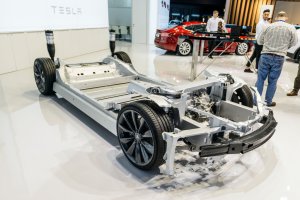
Under the floor, Tesla’s newest battery and drive unit deliver 1 MW of power. Merritt also shared a look at the hardware, which Tesla says offers “one third more power than Model S Plaid-with half the mass.”
In a live test, the Roadster hit 0-60 mph in just 0.81 seconds. Musk said the production car will do better, as long as it doesn’t “detach the retina” of the person inside. Tesla says it can currently reach over 230 mph, and Musk said he wants it to eventually approach half the speed of sound (383 mph).
A New Design for a “Pilot’s Car”
Not a Tesla App
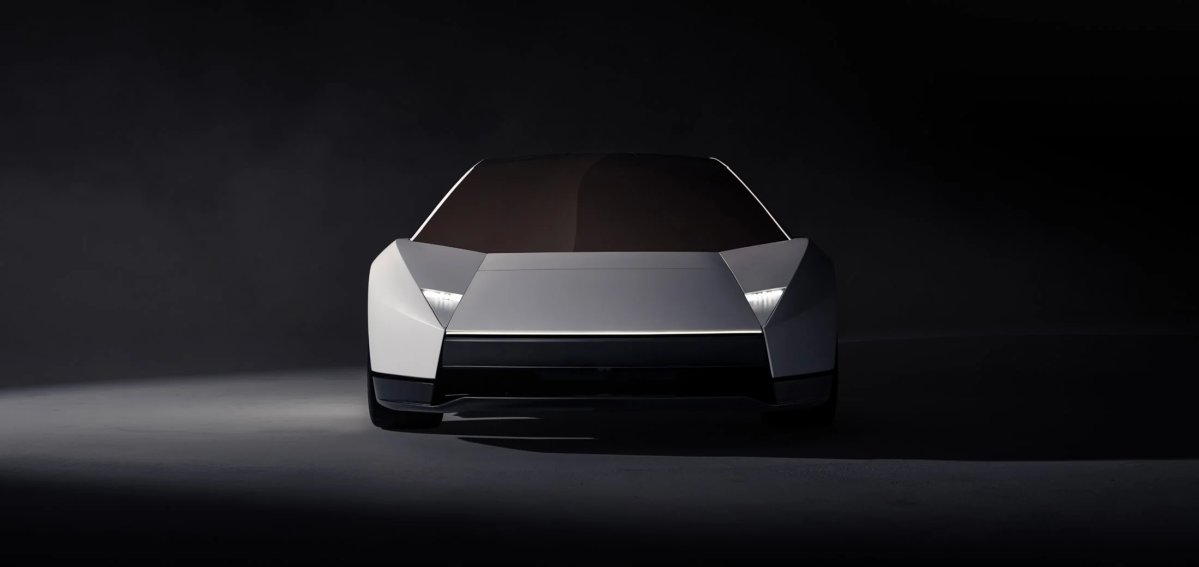
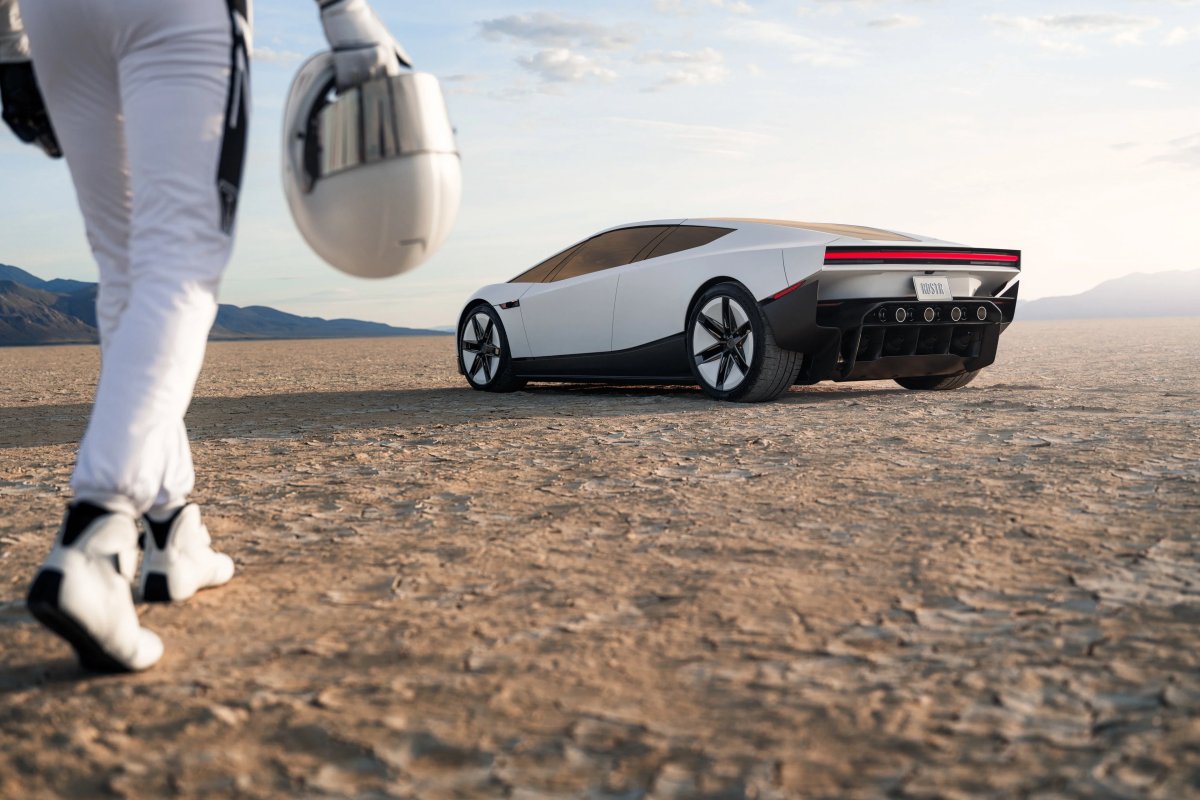
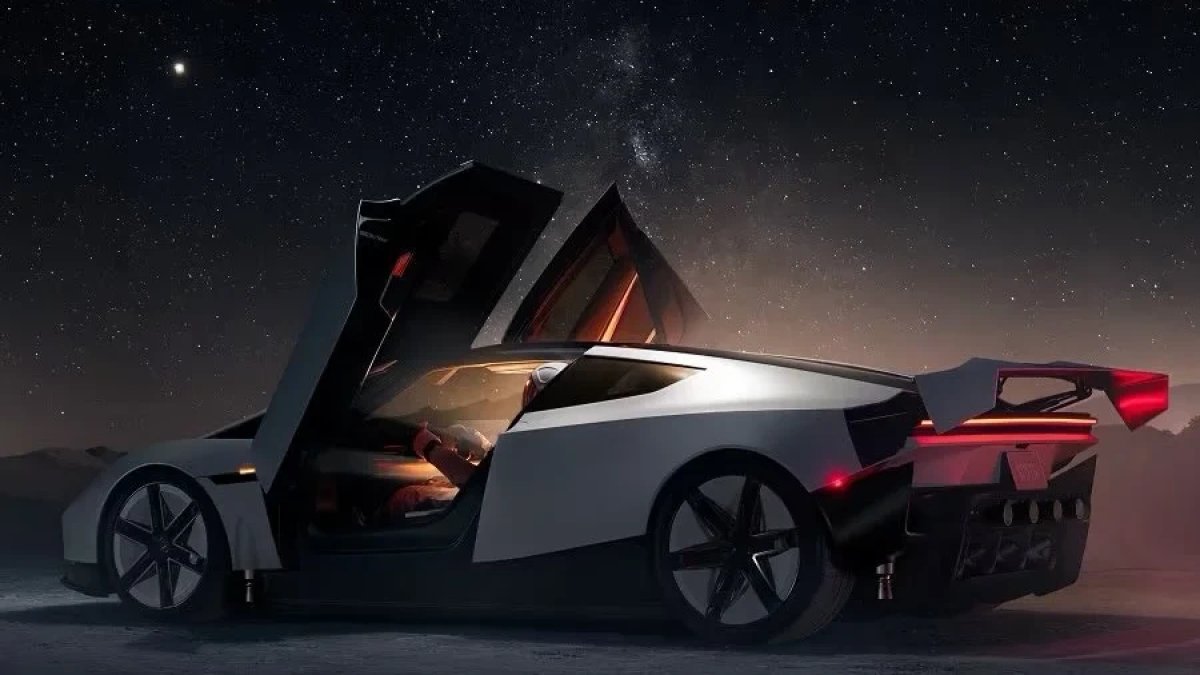
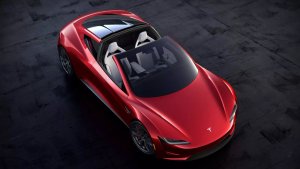
The Roadster has changed a lot since 2017. Instead of the S3XY-inspired concept Tesla originally previewed, it has a low, wedge-shaped supercar silhouette closer to a Lamborghini, with a full-width rear light bar and an exposed diffuser housing the fans and thrusters. Franz von Holzhausen said the design draws on the SR-71 and cars that transform.
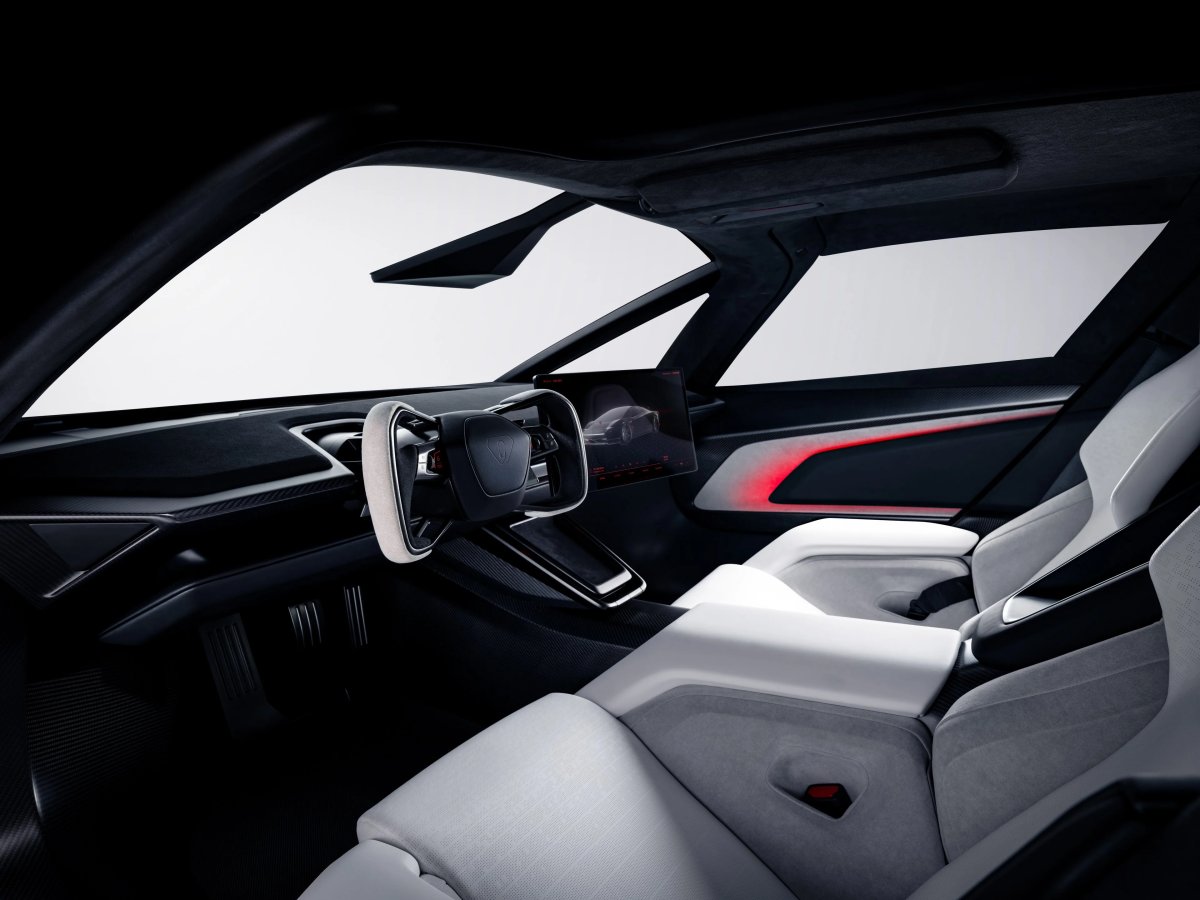
Tesla calls it a true “pilot’s car.” It’s a two-seater with seats molded into the chassis, a steer-by-wire yoke, and by-wire brakes and throttle.
Not a Tesla App
We also got our first look inside the Roadster’s cockpit (of all the vehicle cabins to be called a “cockpit,” the Roadster’s is arguably the most deserving) thanks to Merritt, complete with the UI. Granted, much of the interior and user interface is liable to change between now and the first deliveries. Take a look below:
Trims, Price, and Production
The new Roadster comes in Ano White, an aerospace-inspired colorway. Tesla is offering the Roadster in three trims:
Performance: Road-ready, with active aero and the suction system, plus a 0-60 time of under 1.6 seconds.
Thrust: Race-ready, adding acceleration thrusters for 0-60 in under 0.9 seconds.
Rocket: Invite-only and seating just one, with a full flight system and 0-60 in under 0.59 seconds. Tesla’s new Roadster page notes it won’t be available in all regions.
Not a Tesla App
Tesla hasn’t announced final pricing, but Performance reservations require a (refundable) $50,000 deposit, while Thrust requires $250,000. Production starts in 2028.
The show isn’t over, either. Musk teased follow-up demos, including another attempt at Evel Knievel’s jump over Snake River Canyon. As Musk put it, “Where we’re going, you don’t need tires.” If you missed it, you can watch the full Roadster reveal replay on our event page.
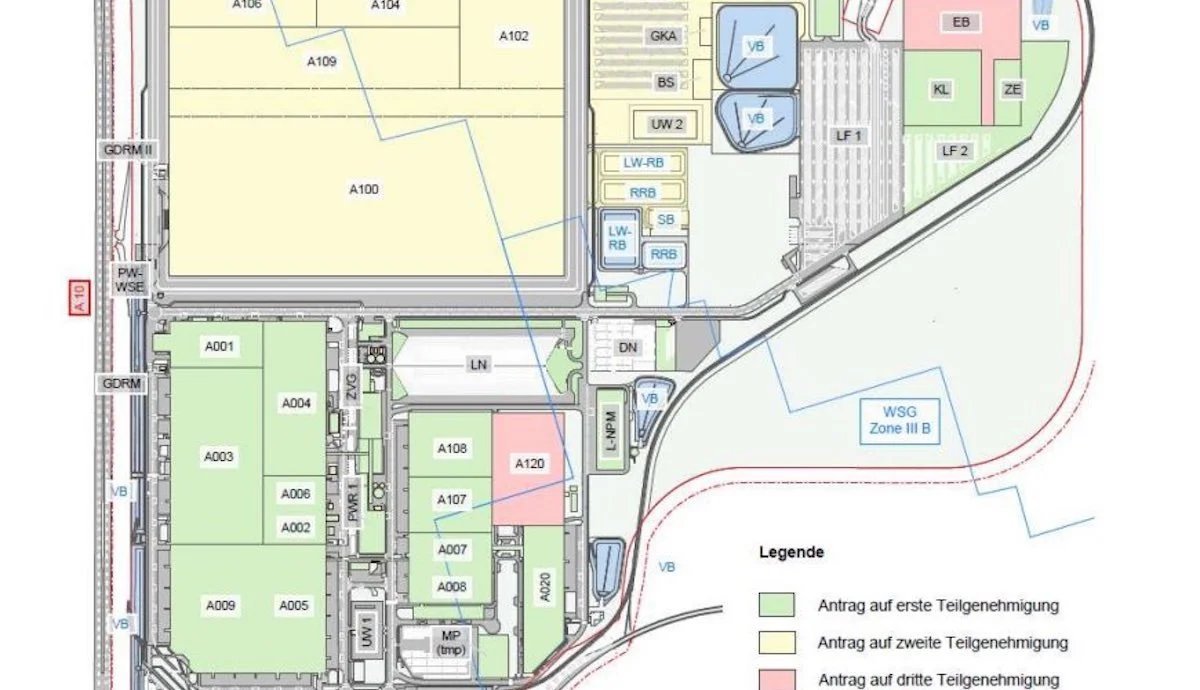
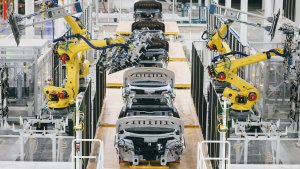
Tesla is moving ahead with plans to turn Giga Berlin into a factory capable of building 1 million vehicles per year. As @alex_avoigt shared on X, citing a report from German broadcaster rbb, Tesla plans to build a second production hall north of the existing plant in Grünheide, with construction set to begin in 2027.
Tesla has talked about a 1-million-vehicle target since the factory’s early construction phases, but this would be the first step toward actually building it out. At that level, the European factory would sit right alongside Tesla’s largest manufacturing hub, Giga Shanghai, in annual capacity.
A New Production Hall Twice the Size
According to rbb, the new hall would cover about 5.76 million sq. ft (536,000 sq. meters), more than twice the roughly 2.35 million sq. ft (219,000 sq. meters) of the current building. Tesla plans to submit its permit applications in December, and the full expansion is expected to take about ten years.
@alex_avoigt / X
In a statement, Tesla said it outlined the phased expansion back in 2023. It added that an approval notice from October 2024 “confirmed that the project is, in principle, eligible for approval,” and the new permit application for the northern building builds on that.
Giga Berlin Has Been Ramping Up All Year
Giga Berlin’s output target is now 7,500 vehicles per week, or roughly 375,000 per year. Reaching 1 million would nearly triple that.
Giga Berlin currently builds the Model Y for Europe and several export markets, including Canada. The extra space could also make room for new products. Musk said earlier this year that the Cybercab is the “most likely next major product” for Giga Berlin, with Optimus possibly following, and he recently said he hopes to bring the Cybercab to Europe soon.
The expansion also follows through on a promise Tesla leadership made to workers. Major growth at Giga Berlin was tied to employees voting against a union majority in the factory’s labor elections earlier this year.
If permits come through on schedule, construction on the new hall could start next year. The 1-million-vehicle target is still a long way off, with Tesla planning the expansion over roughly the next decade.