






![Tesla Tinkerers Get CarPlay and AirPlay Running Natively [VIDEOS]](/img/containers/article_images/2026/tesla-apple-carplay-native-implementation-michal-gapinski-1792010425.webp/7fe054ed40a27b27138ef59bd1f3f373/tesla-apple-carplay-native-implementation-michal-gapinski-1792010425.jpg)




FSD Beta v11.3 Release Notes

- Enabled FSD Beta on highway. This unifies the vision and planning stack on and off-highway and replaces the legacy highway stack, which is over four years old. The legacy highway stack still relies on several single-camera and single-frame networks, and was setup to handle simple lane-specific maneuvers. FSD Beta's multi-camera video networks and next-gen planner, that allows for more complex agent interactions with less reliance on lanes, make way for adding more intelligent behaviors, smoother control and better decision making.
- Added voice drive-notes. After an intervention, you can now send Tesla an anonymous voice message describing your experience to help improve Autopilot.
- Expanded Automatic Emergency Braking (AEB) to handle vehicles that cross ego's path. This includes cases where other vehicles run their red light or turn across ego's path, stealing the right-of-way. Replay of previous collisions of this type suggests that 49% of the events would be mitigated by the new behavior. This improvement is now active in both manual driving and autopilot operation.
- Improved autopilot reaction time to red light runners and stop sign runners by 500ms, by increased reliance on object's instantaneous kinematics along with trajectory estimates.
- Added a long-range highway lanes network to enable earlier response to blocked lanes and high curvature.
- Reduced goal pose prediction error for candidate trajectory neural network by 40% and reduced runtime by 3X. This was achieved by improving the dataset using heavier and more robust offline optimization, increasing the size of this improved dataset by 4X, and implementing a better architecture and feature space.
- Improved occupancy network detections by oversampling on 180K challenging videos including rain reflections, road debris, and high curvature.
- Improved recall for close-by cut-in cases by 20% by adding 40k autolabeled fleet clips of this scenario to the dataset. Also improved handling of cut-in cases by improved modeling of their motion into ego's lane, leveraging the same for smoother lateral and longitudinal control for cut-in objects.
- Added "lane guidance module and perceptual loss to the Road Edges and Lines network, improving the absolute recall of lines by 6% and the absolute recall of road edges by 7%.
- Improved overall geometry and stability of lane predictions by updating the "lane guidance" module representation with information relevant to predicting crossing and oncoming lanes.
- Improved handling through high speed and high curvature scenarios by offsetting towards inner lane lines.
- Improved lane changes, including: earlier detection and handling for simultaneous lane changes, better gap selection when approaching deadlines, better integration between speed-based and nav-based lane change decisions and more differentiation between the FSD driving profiles with respect to speed lane changes.
- Improved longitudinal control response smoothness when following lead vehicles by better modeling the possible effect of lead vehicles’ brake lights on their future speed profiles.
- Improved detection of rare objects by 18% and reduced the depth error to large trucks by 9%, primarily from migrating to more densely supervised autolabeled datasets.
- Improved semantic detections for school busses by 12% and vehicles transitioning from stationary-to-driving by 15%. This was achieved by improving dataset label accuracy and increasing dataset size by 5%.
- Improved decision making at crosswalks by leveraging neural network based ego trajectory estimation in place of approximated kinematic models.
- Improved reliability and smoothness of merge control, by deprecating legacy merge region tasks in favor of merge topologies derived from vector lanes.
- Unlocked longer fleet telemetry clips (by up to 26%) by balancing compressed IPC buffers and optimized write scheduling across twin SOCs.
New Visualizations
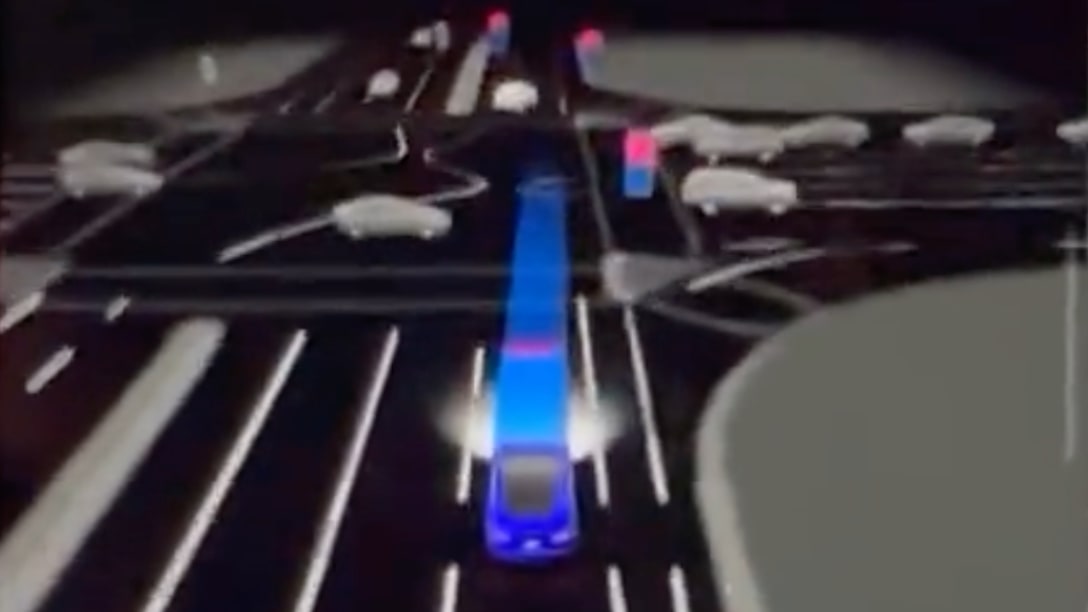
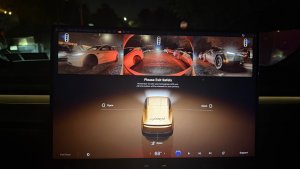
This update includes new visualization, including new traffic lights, a different color scheme for road edges and a high-level view when crossing intersections.
There are likely more visualizations that we haven't seen yet, so stay tuned for more details.
FSD Profiles Shortcut
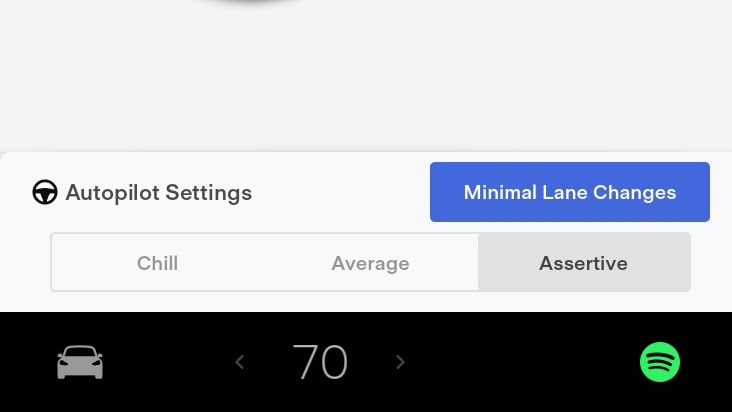
Tilting the right scroll wheel left/right will now adjust the FSD Profile from Chill to Average to Assertive.
This is the same profile that shows up in the Controls > Autopilot menu.
Before FSD Beta was enabled on the highway, the right scroll wheel would adjust the follow distance from 2 to 7.

