







Automatic Collision Evasion

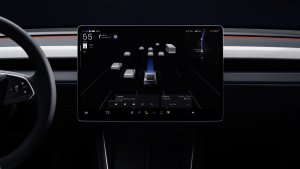
Automatic Collision Evasion activates Full Self-Driving (Supervised) to try to keep your vehicle safe and then continue driving. It can engage in the following situations while you are driving manually:
- Scenario 1: A frontal collision is imminent and braking alone may not avoid it.
- Scenario 2: Your vehicle detects that you are not sufficiently attentive to the road (for example, reaching toward the back seat), or that Full Self-Driving (Supervised) may have been unintentionally disengaged.
See your Owner's Manual for more details.
FSD (Supervised) v14.3.9

Full Self-Driving (Supervised) v14.3.9 includes:
- Upgraded the Reinforcement Learning (RL) stage of training the FSD neural network, resulting in improvements in a wide variety of driving scenarios.
- Upgraded the neural network vision encoder, improving understanding in rare and low-visibility scenarios, strengthening 3D geometry understanding, and expanding traffic sign understanding.
- Rewrote the AI compiler and runtime from the ground up with MLIR, resulting in 20% faster reaction time and improving model iteration speed.
- Mitigated unnecessary lane biasing and minor tailgating behaviors.
- Increased decisiveness of parking spot selection and maneuvering.
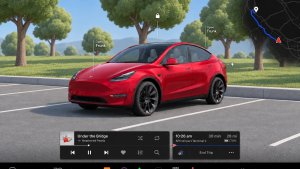
- Improved parking location pin prediction, now shown on a map with a P icon.
- Enhanced response to emergency vehicles, school buses, right-of-way violators, and other rare vehicles.
- Improved handling of small animals by focusing RL training on harder examples and adding rewards for better proactive safety.
- Improved traffic light handling at complex intersections with compound lights, curved roads, and yellow light stopping — driven by training on hard RL examples sourced from the Tesla fleet.
- Improved handling for rare and unusual objects extending, hanging, or leaning into the vehicle path by sourcing infrequent events from the fleet.
- Improved handling of temporary system degradations by maintaining control and automatically recovering without driver intervention, reducing unnecessary disengagements.
- Improved driver monitoring system sensitivity with better eye gaze tracking, eye wear handling, and higher accuracy in variable lighting conditions.
- Unified the model between Actually Smart Summon, FSD, and Robotaxi for more capable and reliable behavior.
- Help Tesla improve Self-Driving by selecting an intervention reason on the main screen after taking over.
- You can now see distance traveled in FSD (Supervised) without an intervention. The Self-Driving App will also show your longest intervention-free streak.
- Parking options now display on the map when arriving at your destination.
Upcoming Improvements:
- Expand reasoning to all behaviors beyond destination handling.
- Add pothole avoidance.
Pełna samodzielna jazda (pod nadzorem)

Funkcja Pełna samodzielna jazda (pod nadzorem) może prowadzić pojazd Tesla niemal w każdych warunkach, z zachowaniem Twojego nadzoru. Po uruchomieniu funkcji na postoju pojazd będzie zmieniać pasy, skręcać na rozwidleniach według trasy nawigacji, omijać inne pojazdy i przedmioty oraz skręcać w lewo i prawo, a na koniec zaparkuje w miejscu docelowym. Zarówno Ty, jak i każda upoważniona osoba, musicie zachować dodatkową ostrożność i uwagę. Funkcja nie sprawia, że pojazd jest autonomiczny. Nie należy lekceważyć zagrożeń.
W pojeździe włączono funkcję Pełna samodzielna jazda (pod nadzorem). Aby skorzystać z tej funkcji, naciśnij przycisk Uruchom funkcję Samodzielna jazda w interfejsie użytkownika lub naciśnij jeden raz prawe pokrętło przewijania. Funkcję Pełna samodzielna jazda (pod nadzorem) można wyłączyć w Ustawieniach Autopilota.

