As Tesla continues to lay the groundwork for its highly anticipated Cybercab and Robotaxi network, a common misconception is that it is entering an empty arena.
The reality is that the autonomous vehicle (AV) market in 2026 is already fiercely competitive, heavily capitalized, and rapidly scaling to beat Tesla at its own game.
While Tesla is betting everything on a vision-only, end-to-end neural network approach, the rest of the industry has largely embraced sensor-heavy redundancy, partnering with major ride-hailing networks like Uber to bypass the struggles of consumer acquisition.
Here is exactly where the biggest players in the robotaxi space stand today, how their technology works, and whether they can actually scale to challenge Tesla's ambitions.
The American Heavyweights
Waymo

Google (Alphabet)’s Waymo is the current market leader in the United States. Waymo is using a sensor-heavy approach to achieve Level 4 autonomy, and is now on its sixth generation of hardware. The current Waymo Driver uses an optimized array of 13 cameras, 4 lidars, and 6 radar units to cut its sensor suite costs by ~40%.
As of early 2026, the company operates in 10 major U.S. metro regions, including San Francisco, Los Angeles, Phoenix, Atlanta, Austin, Miami, Dallas, Houston, San Antonio, and Orlando.
With an active fleet estimated between 2,500 and 3,000 vehicles, Waymo’s scalability is currently unmatched in the United States. The company is completing 400,000 paid rides per week and is targeting 1 million weekly rides by the end of 2026. To support this growth, Waymo operates a dedicated integration plant in Mesa, Arizona, capable of producing tens of thousands of units per year, and is actively transitioning its fleet to Zeekr Ojai vans and Hyundai IONIQ 5s.
Zoox

Acquired by Amazon in 2020 for $1.3 billion, Zoox has taken a radically different hardware approach. Rather than retrofitting existing consumer cars, Zoox relies on purpose-built, bi-directional pods designed strictly for passengers.
These vehicles have no steering wheel or pedals and utilize a heavy mix of cameras, radar, and lidar. The company is currently running testing and limited services in Las Vegas and San Francisco, with testing expanding to Dallas, Seattle, and Miami.
While Zoox's scalability is incredibly high, it has historically been bottlenecked by the law. Because the vehicles lack manual controls, the company relies on federal NHTSA exemptions to deploy.
However, Zoox recently unlocked a massive network opportunity: its robotaxis are officially launching on the Uber app in Las Vegas in Summer 2026, followed by Los Angeles in 2027.
The Cautionary Tale of Cruise
General Motors' Cruise serves as the industry's ultimate cautionary tale. Cruise originally relied on retrofitted Chevy Bolts equipped with cameras, radar, and lidar, and was aggressively scaling across the U.S.
However, after a disastrous rollout in San Francisco, highlighted by a severe accident where a robotaxi dragged a pedestrian, the company lost public trust and its regulatory permits. Facing $10 billion in total losses, GM officially folded Cruise's original robotaxi program.
Shortly after, GM pulled funding for further dedicated robotaxi development, deciding that the time and resources required to scale simply weren't worth the financial bleeding.
The Chinese Powerhouses
Apollo Go

Backed by China's premier search and AI giant Baidu, Apollo Go operates with a massive global footprint. The company employs Level 4 autonomy in its 6th-generation Yichi 06 vehicles, which feature 5 lidars and lack a steering wheel. Apollo Go operates in 22 cities and recently launched a fully driverless commercial service on Yas Island in Abu Dhabi.
Baidu's scalability is practically limitless. Apollo Go currently processes over 250,000 weekly driverless rides and has logged over 17 million cumulative rides to date. Because their 6th-generation vehicle costs under $29,000 to manufacture, they are able to scale extremely quickly, at a price competitive to Tesla’s upcoming Cybercab.
The company is approaching unit profitability in major markets like Wuhan and is actively partnering with Uber to deploy thousands of vehicles globally.
Pony.ai
Recently listed on both the HKEX and NASDAQ, Pony.ai is an independent Chinese startup making massive waves. Their 7th-generation sensor suite relies heavily on lidar and cameras bolted onto BAIC and Toyota vehicle platforms.
Currently operating in Tier-1 Chinese cities like Guangzhou, Shenzhen, Beijing, and Shanghai, the company operated 1,159 vehicles as of late 2025. Having achieved unit economics breakeven in Guangzhou (averaging 23 daily customer trips per vehicle), Pony.ai plans to expand its active fleet to over 3,000 vehicles by the end of 2026.
WeRide
WeRide is an independent autonomous driving startup that just executed a massive manufacturing leap. Utilizing Level 4 autonomy, WeRide operates the purpose-built Robotaxi GXR built on Geely Farizon's Super VAN platform.
The vehicle uses an AI steer-by-wire chassis and the GEN8 sensor suite, featuring a thousand-beam lidar that can detect objects up to 600 meters away.
Operating across China, Singapore, and the Middle East (Abu Dhabi, Dubai, Riyadh), WeRide has been working to rapidly scale on the other side of the world. In March 2026, the company signed a massive order with Geely to deliver 2,000 new Robotaxi GXRs.
Their new manufacturing partnership slashed vehicle assembly time to under 10 minutes, and they expect their global fleet to surpass 2,600 active vehicles this year on their way to tens of thousands by 2030.
Other Players
Nuro

Nuro is famous for its small, autonomous delivery pods, but the startup recently executed a massive pivot into passenger robotaxis. At CES 2026, Nuro announced a new partnership backed by Uber to integrate its Level 4 autonomy systems into the Lucid Gravity SUV.
This premium robotaxi fleet will leverage Nvidia's DRIVE AGX Thor compute platform and Gravity's massive 450-mile range to drastically reduce charging downtime. Uber plans to deploy 20,000 or more of these Lucid-Nuro robotaxis across global markets over the next six years, with the first vehicles hitting the streets in late 2026.
Aurora
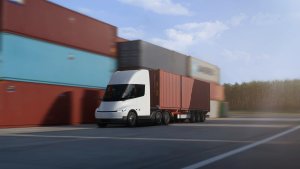
Aurora is not competing with Tesla for passenger ride-hailing; they are the future competition for FSD on the Tesla Semi.
Aurora is laser-focused on Class 8 heavy-duty trucking. Originating as an independent company that previously acquired Uber's self-driving unit, Aurora utilizes its FirstLight Lidar (capable of seeing over 450 meters ahead), alongside cameras, radar, and "Verifiable AI."
They currently operate daily commercial driverless routes in Texas and plan to scale to a couple of hundred driverless trucks across the Southern U.S. by the end of 2026.
Rimac Verne
Spearheaded by hypercar legend Mate Rimac, Verne is targeting a highly premium, luxury robotaxi experience.
Built on Mobileye's Drive platform (13 cameras, 9 lidar, 5 radar), the vehicle is a two-seat pod with sliding doors, no steering wheel, a massive 43-inch screen, and seats that recline fully flat.
While they have agreements with 11 cities across Europe and the Middle East, they are scaling as a boutique offering rather than a mass-market Uber competitor. Verne has built 60 validation prototypes and plans to officially launch on-road services in Zagreb, Croatia in Spring 2026.
NVIDIA

While Nvidia does not operate its own robotaxi fleet, they are the arms dealer of the AV industry, providing both the hardware and the software.
Their DRIVE AGX Hyperion 10 and Thor architectures provide the computing brains for a massive chunk of the market, including Lucid, Nuro, Mercedes, WeRide, and Aurora.
Nvidia recently partnered directly with Uber to scale a global autonomous fleet targeting 100,000 vehicles by 2027 using Nvidia's AI infrastructure.
While Tesla leads autonomy in the Western consumer market, there is a lot of competition in other categories. The holy grail is providing transportation for people and goods at scale.