Right around the self-induced deadline, Tesla released FSD v14 at about midnight Pacific. The update was released to early access testers and a small group of owners.
This is the first meaningful update to FSD in more than six months, and it comes roughly a year after FSD v13 was introduced in November 2024.
While this update has been a long time coming, it does not disappoint in terms of improvements and feature additions. This is an action-packed update that includes improvements to almost every aspect of FSD.
Let’s go through the biggest feature changes.
Parking at Destination
Tesla has finally introduced the ability for the vehicle to park itself when it arrives at its destination. Not only will the vehicle park itself when it arrives, but the user will be able to choose the preferred parking method.
Under parking options, users can select from Street, Parking Lot, Driveway, Parking Garage, or Curbside; however, the available options will vary based on the destination.
When the vehicle arrives at the destination, it’ll then attempt to park using your preferred method. It’ll even park head-first into a parking spot, instead of backing in like Autopark does today.
By default, an AI model will try to pick the most reasonable parking option for the given destination, but if you manually select a parking option, the vehicle will remember it for that destination.
Tesla FSD V14.1 just parked in the exact parking spot that I dropped a pin on in the map. Incredible.
— Sawyer Merritt (@SawyerMerritt) October 7, 2025
Gonna do more testing later today. pic.twitter.com/YwszXzHt9a
New Speed Profiles
Tesla has once again updated the speed profiles with FSD v14. In addition to Chill, Standard and Hurry, there is now a new, slower option called Sloth. Sloth mode will reduce speeds and make more conservative lane changes when compared to Chill.
Speed Profiles are now used for more than just lane selection and determining how often the vehicle passes another vehicle. Speed Profiles now also affect the vehicle’s speed. Speed offset used to be a separate option that was controlled independently of the Speed Profile, but now they’re directly tied together. Sloth will travel slower than Chill or Standard, and Standard will have a slower overall speed than Hurry.
In addition to the behavioral changes, Tesla is also modifying the scroll wheel's behavior for FSD. Previously, you would tilt the right scroll wheel left/right to change the Speed Profile, e.g., from Standard to Hurry. Since the vehicle’s max speed is now based on the Speed Profile, scrolling up and down now changes the Speed Profile and therefore affects the vehicle’s speed.
New User Interface

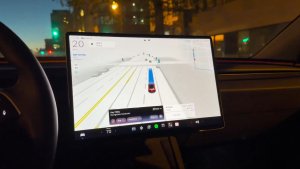
Tesla has updated the UI for FSD v14, making it easier to see which features are selected and allowing users to change them at any time.
Now on the screen, you’ll see the Parking at Destination and Speed Profile at all times, allowing you to switch how you want to park or change your speed profile by interacting with the display. The Speed Profiles now also feature unique graphics for each mode, adding a bit more flair and a larger hit box when tapping them on the screen.
The Start FSD from Park option has been renamed “Start Self-Driving” and it now remains on the screen, instead of just showing it when your vehicle is in park. You can use it to start FSD at any time, which is a nice visual reminder, especially since stalkless vehicles require pressing the right scroll wheel to activate Autopilot/FSD, which isn’t obvious to new owners.
Windshield Visibility
With this update, Tesla is adding an alert when the interior of the windshield in front of the vehicle’s front cameras is foggy or hazy. This typically requires professional cleaning since the rearview mirror and camera housing need to be removed, but it can be a do-it-yourself job if you’re patient and have the right cleaning products.
Over the years, this has become an issue as the area develops a foggy haze, reducing clarity for the cameras behind the glass. Tesla has added cleaning the area as a regular maintenance item to the vehicle’s Maintenance Summary screen. In fact, it’s starting to become so much of an issue that Musk has said it’s a major area of focus at Tesla, and we may see an updated design in the future.
The haze on the windshield can be difficult to see, meaning that many owners may not be aware of the issue. It often requires looking at the windshield at just the right angle with a flashlight. Alerting owners that this area might need cleaning is important, as it can affect FSD’s performance without the owner realizing it.
Yielding for Emergency Vehicles
While FSD would already yield for emergency vehicles in most cases, it looks like Tesla has improved it with this release. The release notes explicitly say the vehicle will now pull over or yield for police cars, fire trucks, and ambulances.
In another section of the release notes, Tesla also highlights school buses, stating that they’re now handled more effectively.
Improved Construction Handling
Tesla says that navigation routing is now part of the neural network, allowing it to handle blocked roads and detours in real-time.
Tesla also says that the vehicle will now handle road debris better, such as tires, tree branches, and boxes.
Update 2025.32.8.5
Percent of Fleet
Installs on Oct 11
This release is absolutely massive and a huge improvement all around to FSD. Officially, this is FSD v14.1, and it comes in as update 2025.32.8.5. Be sure to check out the complete release notes for this release.
If there are no major issues in the coming days, we may see Tesla expand this release to more users. However, it’s more likely that the broader user base will receive FSD v14.2 or FSD v14.3, which are already being planned.