Ever since it made an unexpected entrance rolling out from the trailer of the original Semi concept in late 2017, the second-generation Tesla Roadster has occupied a unique space in automotive lore. Part halo sports car, part engineering moonshot, the vehicle has survived endless date changes, design revisions, and outlandish promises.
Now, the wait is almost over. After years of speculation and hype, Tesla has officially set an October 1 event for the Roadster reveal and began sending invites to reservation holders, complete with an active countdown clock on its website. With the event only weeks away, here’s a complete rundown of everything we know so far and what to expect when the covers finally come off in Texas.
An “Unforgettable” Demo
Getting to this unveiling has been a long journey. Internal targets previously penciled in a reveal as early as April 1, 2026, before slipping into late spring and then late summer. Elon Musk has spent years building anticipation for the Roadster 2.0, repeatedly stating that the car’s public demonstration would be “unforgettable.”
During a recent appearance at the All-In Summit, Musk reiterated how wild the presentation will be now that it’s finally on the books, stating:
“It’ll be a banger. Excitement guaranteed. Success is not guaranteed, but excitement is.”
He went on to add:
“We actually need an audience to vouch for the fact that this is not AI.”
Elon Musk says Tesla’s upcoming Roadster unveil will need an audience to prove what people are seeing is not AI.
— DogeDesigner (@cb_doge) September 15, 2026
“It’ll be a banger. Excitement guaranteed. Success is not guaranteed, but excitement is.”
“We actually need an audience to vouch for the fact that this is not AI.” https://t.co/umN7gmv4uq pic.twitter.com/ZeawMVs4xL
The comments suggest Tesla will demonstrate the Roadster’s capabilities live on stage rather than relying on pre-recorded videos or animations, putting attendees directly in front of the action.
Unbelievable Speed
Tesla’s refreshed Roadster is designed to stand as the undisputed halo product, not just of Tesla’s lineup but of the EV industry as a whole, resetting straight-line metrics for production cars.

Musk has previously promised a sub-2-second 0-60 mph acceleration time for the base configuration, as well as a borderline absurd 0-60 mph sprint of under or around one second flat when equipped with optional propulsion hardware (more on that in a bit). Reaching those speeds would push the physical limits of traditional rubber tires, requiring non-traditional engineering to overcome standard mechanical traction limits.
Banned F1 Tech
Keeping a car planted to the asphalt at record speeds requires serious downforce. Last year, Tesla patented race-banned F1 aero tech for the next-gen Roadster that mimics the ground-effect fan systems once used in Formula 1 racing.

The patented setup incorporates an internal airflow duct running from the front bottom of the vehicle directly through to the rear diffuser. By venting air through this channel, the system creates an underbody low-pressure vacuum. This suction effect pulls the vehicle down toward the pavement, generating massive aerodynamic grip at high speeds without requiring a massive drag-inducing rear wing.
New One-Piece Sport Seats
Holding passengers securely during violent acceleration requires innovative interior seating. Another recent Tesla patent revealed a one-piece seat design for the next-gen Roadster constructed out of composite carbon-nylon or Kevlar-nylon.

Borrowing lessons from the large structural megacastings used in Tesla’s vehicle chassis, the seat shell is stamped as a single structural piece. According to patent drawings, the seat features an integrated “living hinge” and offers six degrees of movement, providing lightweight rigidity that can easily withstand hypercar-level g-forces while shedding cabin weight.
Cold Gas Thrusters
The most sensational claim surrounding the sports car is Musk’s assertion that it will be able to “fly.” A more level-headed interpretation of Musk’s remarks suggests that the new Roadster might be able to briefly lift itself off the ground or hop short distances using the optional SpaceX thruster package that has been teased for years.
The setup utilizes ultra-high-pressure composite overwrapped pressure vessels (COPV) feeding cold gas thruster nozzles tucked into the vehicle body. Recently circulated video footage captured outside a covered SpaceX test enclosure shows the silhouette of what appears to be a vehicle venting gas and briefly lifting off the tarmac, adding credibility to the hardware package.
I'll just put this out there https://t.co/VfpgpWLg0H pic.twitter.com/65i2ZmSEvl
— TheSpaceEngineer (@mcrs987) September 13, 2026
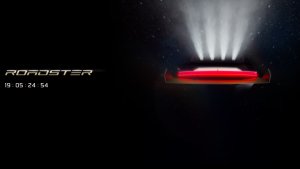
These thrusters will be a first for a production car, enabling never-before-seen levels of acceleration and potentially catapulting the Roadster into a sub-one-second 0-60 mph sprint. Tesla’s updated countdown site for the Roadster event even features an inverted render displaying four distinct thruster plumes firing out of the vehicle’s rear frame.
Cyber(?) Design
Speaking of the shadowed, upside-down render Tesla shared to build hype for the Roadster event, it also provides clues about styling. The teaser highlights a high-mounted active spoiler, sculpted rear fenders, and a continuous horizontal light bar.

Interestingly, the styling appears sharper and more geometric than the curvy 2017 concept car, leading to speculation that the Roadster could adopt styling cues from the Cybertruck. Lending some credence to this theory, the official Tesla website now switches to the angular “Cybertext” font when you go to the Roadster page. However, none of the new Roadster icons and wordmarks Tesla trademarked earlier this spring pointed to this kind of design language.

Next-Gen Steering Tech
Maneuvering a vehicle with active thrusters and variable ground-effect downforce requires precise steering. A recent Tesla patent showed a new steer-by-wire system that doubles rotational range compared to existing setups, and we speculated at the time that this tech could find its way into the upcoming Roadster.

Implementing variable-ratio steer-by-wire without a physical steering column would allow the vehicle to adjust rack sensitivity dynamically based on velocity, making high-speed track maneuvers razor-sharp while keeping low-speed parking turns effortless.
Production and Price
Production is slated to take place in Texas. In previous executive interviews, engineering teams confirmed that alpha prototypes of the next-gen Roadster were actively testing and that commercial assembly will be based at Gigafactory Texas in Austin.
Pricing for the Roadster 2.0 remains unconfirmed at this time. We previously estimated that the standard variant could start at around $200,000, with the limited-edition Founder’s Series costing around $250,000. Final retail figures and delivery estimates should come to light during the October 1 event.
The Long Road to Waco
The second-generation Roadster was originally unveiled way back on December 14, 2017. Following nearly nine years of engineering hurdles, battery chemistry evolutions, and platform delays, the sports car is finally arriving at the start line. Check out Tesla’s 2017 unveiling of the Roadster below:
Given how heavily leadership has hyped the machine over the past decade, Tesla is widely expected to livestream the Waco showcase to a worldwide audience on October 1. Exact specs for the next-gen Roadster are anyone’s best guess right now, but stay tuned for our full coverage of the event to learn more. Whether the rocket thrusters, banned F1 downforce tech, and sub-one-second sprint times live up to the talk, the event is shaping up to be an extraordinary demonstration.