For years, the automotive industry has relied heavily on the Global Positioning System (GPS) to guide vehicles from point A to point B. While traditional GPS is excellent for highway cruising, it has a massive, undeniable blind spot. The moment a vehicle drives underground, enters a multi-level concrete parking garage, or navigates a dense urban canyon, that crucial satellite signal vanishes.
For a human driver, losing a map signal in a parking garage is a minor annoyance. For an autonomous vehicle, it is a catastrophic loss of orientation.
However, a newly published Tesla patent titled "Modeling Techniques for Vision-Based Path Determination" (US 2026/0098740) reveals exactly how the automaker is solving this infrastructure blind spot.
By ditching external satellite mapping entirely in favor of an advanced, self-contained visual architecture, Tesla is not only solving the parking garage problem for its upcoming Robotaxi fleet but also building the foundational navigation brain for the Optimus humanoid robot.
The Problem with Concrete Canyons
To understand the brilliance of Tesla's new patent, one must first understand how traditional localization works. Most autonomous systems use a combination of pre-mapped high-definition GPS coordinates and localized sensors to figure out exactly where they are in the world.
When a vehicle enters a multi-level parking garage, the concrete and steel rebar completely block the GPS signal. Without that satellite connection, a traditional autonomous system cannot pinpoint its location, map a route to an empty space, or find the exit. The vehicle is effectively flying blind in a highly complex, tightly packed environment filled with moving pedestrians, rogue shopping carts, and unpredictable human drivers.
Tesla realized early on that if it wanted to build a truly unsupervised Robotaxi network, its vehicles could never rely on a signal they do not control. If a Robotaxi gets stranded on level four of an underground mall garage because it lost connection to a satellite, the entire model fractures. The vehicle must be able to localize itself and navigate using only onboard hardware.
How the Vision-Based Brain Works

The newly published patent outlines a highly sophisticated method for Tesla’s FSD ego to understand its environment, localize its position, and navigate to a destination entirely without the use of GPS or external location-tracking sensors. Notably, the patent explicitly defines this ego as either an autonomous vehicle or a humanoid robot.
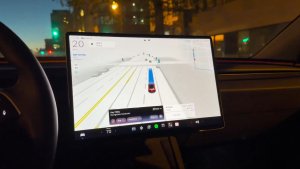
Instead of looking for a satellite, the ego relies purely on its live camera feeds to build a real-time, 3D model of its surroundings. It accomplishes this through a deeply complex Occupancy Network.
The vehicle's computer divides the physical space around it into tiny, three-dimensional cubes called voxels. In real time, the neural network evaluates each voxel to determine two critical things. First, it determines occupancy. Is this specific cube of space empty air, or is it occupied by a physical mass like a concrete pillar or a parked car? Second, it determines surface attributes. The system categorizes the surfaces it sees, differentiating between drivable asphalt, a concrete sidewalk, or a painted parking line.
GPS-Free Localization via Vision
Mapping the environment is only half the battle. The vehicle still needs to know its exact location within that newly generated map. This is where the patent details a massive leap forward in GPS-free localization.
As the cameras sweep the parking garage, the neural network identifies unique visual anchors in the environment, which the patent refers to as "key image features." These features could be anything highly distinct, such as a brightly painted exit sign, a fire extinguisher on a pillar, or a specific crack in the concrete wall.
The vehicle's computer locks onto these key image features and tracks how they move across successive video frames as the car rolls forward. By measuring the changing distance and angle of these unique visual anchors relative to the cameras, the vehicle can mathematically pinpoint its own exact location within its internally generated 3D map. It essentially creates its own localized universe and tracks its movement through it, completely independent of the outside world.
Once the vehicle knows exactly where it is and what the environment looks like, the system uses trajectory optimization protocols. The patent specifically cites the use of an Iterative Linear Quadratic Regulator. This protocol takes the 3D voxel map and calculates the safest, smoothest path forward, constantly adjusting the vehicle's forward velocity, lateral movement, and yaw rate to glide around obstacles and reach the designated parking spot.
Solving the Parking Garage for FSD
We are already seeing the real-world application of this specific patent in the consumer fleet today. This vision-based localization is the exact technological foundation that allows Actually Smart Summon to function so effectively.
FSD v14.3.2 enters a parking garage, pulls right up to the ticket dispenser and proceeds when it opens. pic.twitter.com/HjvBYdcCft
— Zack (@BLKMDL3) April 26, 2026
When an owner calls their vehicle across a parking garage, the car is not using GPS to find them. It is utilizing this voxel-based occupancy network to build a 3D map of the lot, identifying key image features to track its progress, and plotting a dynamic path around pedestrians and returning shopping carts.
As Full Self-Driving continues to evolve, this localized visual mapping will allow consumer vehicles to confidently enter complex underground structures, navigate the labyrinth to find an open space, park, and eventually un-park and find the exit, all without a single drop of satellite data.
The Ultimate Challenge: Optimus
Perhaps the most fascinating aspect of this patent is its direct application to the Optimus program. While autonomous cars occasionally deal with GPS dead zones, humanoid robots exist almost entirely within them.
Whether an Optimus unit is carrying heavy castings across the floor of Gigafactory Texas or folding laundry inside a consumer's living room, it will never have a reliable GPS signal. The robot must be able to understand its environment, navigate around dynamic obstacles, and know exactly where it is standing using only the cameras located in its head.
Because Tesla has engineered its AI to be universally applicable, the exact same neural network architecture described in this patent powers both the car and the robot. Optimus uses the same cameras to generate the same 3D voxel map. It identifies key image features in a living room, such as a television set or a distinct couch cushion, to localize its position within the house. It then uses the same trajectory optimization protocols to calculate the safest path to the kitchen without tripping over a coffee table.
By solving the parking garage problem for its vehicles, Tesla has also solved the indoor navigation problem for its humanoid robots. This patent serves as a masterclass in vertical integration and architectural efficiency. While competitors spend millions mapping cities with high-definition lidar and relying on fragile satellite uplinks, Tesla has built a localized, vision-only brain that can navigate the most complex environments on Earth, regardless of whether that brain is driving on four wheels or walking on two legs.
If you enjoyed this article, we recommend reading our full series on Tesla patents related to FSD:
Tesla’s Universal AI Translator
How Tesla Will Label Data with AI
How Tesla Solves for GPS Deadzones (This Article)