The road to getting Full Self-Driving (Supervised) approved across the European Union has felt like a bureaucratic maze, but Europe’s biggest automotive powerhouse has officially clarified where it stands. Germany’s Federal Ministry for Transport (BMDV) has confirmed that a decisive vote on EU-wide recognition is currently scheduled for December 2026 after it was delayed from October 6.
The official correspondence came to light after @TeslaDE195932 shared a response from the BMDV’s citizen service division on X. While confirming that the Technical Committee – Motor Vehicles (TCMV) will hold further consultations on October 6 ahead of the December vote, the German ministry gave a candid look into its internal evaluation.
Technology-Open, But Skeptical on Speeding
According to the ministry, Germany is maintaining a “technology-open and safety-oriented” approach. Germany’s Federal Motor Transport Authority (KBA) is currently in direct talks with Dutch vehicle authority RDW — which was responsible for giving FSD entry into Europe earlier this spring — and Tesla to examine all technical data before solidifying its voting stance.
Regulators acknowledged that FSD (Supervised) appears capable of managing a wide variety of traffic situations, particularly in complex city driving. However, the BMDV highlighted specific safety reservations that mirror pushback seen elsewhere in Europe:
System Speeding: Regulators expressed concern over FSD automatically exceeding posted speed limits by up to 50% in certain conditions.
Urban Operation: The ministry is reviewing whether driver-assistance features of FSD’s caliber should be allowed to operate on dense inner-city streets.
Driver Liability: Officials stressed that driver responsibility remains absolute — FSD is still classified as an SAE Level 2 system, after all. They warned that in the event of any malfunction or incident, liability rests entirely with the driver rather than the manufacturer.
Where Europe Stands Ahead of December
Germany’s concern about potential overspeeding stems from FSD’s Speed Offset feature and isn’t new. Sweden, France, and Croatia have all voiced identical reservations, as have road safety groups like the European Transport Safety Council (ETSC). Croatia has overcome those qualms and already approved FSD for use on public roads, while Sweden is urging the EU to withhold bloc-wide clearance until Tesla ensures the system strictly adheres to posted limits.
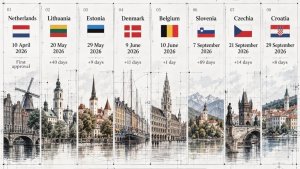
While Germany prepares its official position, the rest of the continent isn’t standing still. Rather than waiting on Brussels, eight European nations have already granted independent national approval for FSD:
Netherlands
Belgium
Denmark
Lithuania
Estonia
Slovenia
Czechia
Croatia.
Meanwhile, Tesla is in talks for FSD approval in Ireland and closing in on a green light in Italy, showing how fast localized support is spreading across the continent.
Whether Germany will eventually issue an independent national permit ahead of the wider EU vote remains to be seen. But with the KBA actively evaluating real-world driving data alongside the Dutch approval framework, Germany’s willingness to engage keeps the door wide open for Tesla to conquer its European home base and the region’s most demanding highway network.