Tesla's upcoming Cybercab is built from the ground up for high utilization and full autonomy, skipping traditional elements like pedals and steering wheels entirely. While we already knew what it looked like on the outside, a deep dive into official government documentation gives us a practical look at how much this vehicle can actually carry.
Cracking the EPA Filings
The numbers come from recent public EPA filings about the Cybercab, which surfaced earlier this week and gave us our first official look at the nitty-gritty details of the Cybercab. These documents revealed key specs, including battery size, electric motor output, curb weight, and Gross Vehicle Weight Rating (GVWR). By looking at the difference between the official curb weight and the GVWR — which is the maximum weight with passengers and cargo that the vehicle is certified for — we can figure out the usable load capacity.


Subtracting those figures leaves the Cybercab with a maximum payload capacity of exactly 617 lbs, or about 280 kg. Alexander Kristensen (@LinkN01) pointed out the max load capacity in a post on X, joking, "I wonder if that spec got decided upon after the advent of Ozempic."
Real-World Scenarios and Constraints
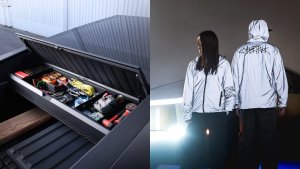
The Cybercab is designed to carry two passengers, but it features a spacious trunk for cargo. Because 617 pounds is more than four times the worldwide average human weight, the limit makes perfect sense for standard ridesharing. Data shows that only 1% of rides involve more than two passengers anyway, but the limit does place some interesting constraints on what you can take along for the ride.

For instance, if two adult passengers weigh a combined 400 pounds, you have 217 pounds left for luggage or cargo. That is plenty of room for a couple of big traveling suitcases on a trip to the airport, although you’re getting close to the weight limit.
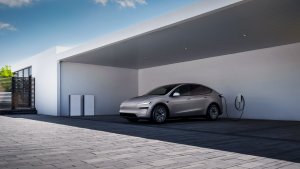
If you’re planning to call a Cybercab to lug a heavy, oversized item from a home improvement store — like a massive AC unit — alongside two heavy passengers, you might push right up against that official certification limit. If you require more space than is available in the Cybercab (for cargo or passengers), Tesla has said that larger, mainstream vehicles like the Model Y will remain available on the Robotaxi network after the Cybercab rolls out to serve those needs.
Coming (Soon?) to a Street Near You
With Tesla now officially certifying its purpose-built autonomous vehicle with the EPA, public deployment could be right around the corner. Over 150 Cybercabs were recently spotted at staging lots in Texas, including more than 100 at Gigafactory Texas.
Mass production officially kicked off at the Texas facility back in late April, and production is ramping up with a mix of steering wheel-less units and ones with steering wheels rolling off the line regularly. Road testing is actively underway, meaning we could see the Cybercab join Tesla’s commercial Robotaxi service as a specialized urban transport option much sooner than initially expected.