With AI continuing to use more of the world’s energy, major AI training deployments need something that no major energy provider can supply - true stability. That stability comes from stationary battery storage - something that Tesla Energy has been deploying in droves.
Now, Tesla Energy has achieved two back-to-back deployment milestones: powering the world’s largest supercomputer in Memphis for xAI, and powering the brains behind the next generation of FSD at its own Giga Texas.
Colossus 2: $585 Million of Batteries
The sheer scale of xAI’s Colossus 2 supercomputer - already the most powerful in the world - now has an equally immense battery backup to match. xAI and Tesla Energy have recently completed the installation of approximately 600 Megapacks at the site in Memphis, Tennessee.
That represents roughly 2.3GWh of energy storage capacity. For context, that is enough energy to power a small city - or back up the massive grid load required by over 100,000 NVIDIA H100 and H200 GPUs present on site.
Based on current Tesla Energy pricing, this represents approximately $585 million, making it one of the largest battery energy storage projects on the planet. Unlike a typical grid utility project, these batteries aren’t here for grid arbitrage.
Instead, they’re serving as a critical buffer for Colossus and Colossus 2, ensuring that the massive power spikes from AI training runs don’t destabilize the local grid or cause brownouts during peak compute loads.
Cortex 2 in Austin
Meanwhile, in Austin, the hardware to train the next generation of FSD - both Unsupervised and for Optimus - is arriving on site.
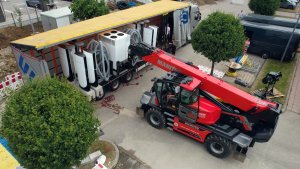
Drone footage captured by Giga Texas observer Joe Tegtmeyer confirms that Tesla has begun taking delivery of Megapacks for its new Cortex 2 Supercomputer. The new Cortex 2 cluster is expected to be a 500MW supercomputer cluster, focused primarily on training for Optimus.
The Cortex 2 chiller systems (Part 1 & 2) are making quick progress at Giga Texas today, with Part 1 having 4 of the 6 fan enclosures, pipe systems and even some exterior wall segments being installed. The overall height of this chiller is significantly higher than the Cortex… pic.twitter.com/HRZxe8qyM1
— Joe Tegtmeyer 🚀 🤠🛸😎 (@JoeTegtmeyer) January 20, 2026
The arrival of Megapacks suggests that Tesla is getting closer to powering up the facility for the first time. Just as in Memphis, these batteries will stabilize the massive 500MW energy load required to train end-to-end neural networks that will allow Optimus to navigate factories, perform complex tasks, and more.
Overcoming Grid Limitations
These two projects highlight a bottleneck in the AI race: Power. As xAI and Tesla race to build these massive training clusters, the limiting factor is no longer just obtaining enough GPU allocations from NVIDIA. Instead, it’s finding the sheer amount of stable electricity to turn them on.
By vertically integrating the battery storage with the compute, Elon Musk is effectively building his own utility infrastructure to bypass grid limitations.