With the launch of any major software update from Tesla, various features slip through the cracks of their release notes — intentionally or unintentionally — leaving them for the community to discover.
With the launch of FSD V14.1, the release notes just tell part of the story, as there are a host of significant, undocumented changes to the user interface, driving profiles, and system logic. With that all said, let’s take a look at everything Tesla didn’t discuss regarding FSD V14.
Removal of Autpilot Icon
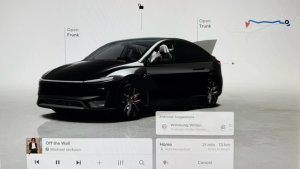
There are several major UI updates included with FSD V14.1. While the release notes point out the new “Start Self-Driving” button and the new on-screen module to select your Speed Profile, there are changes that haven’t been discussed, including the removal of the Autopilot icon. The famous blue circle with the steering wheel is gone in this release, and Tesla is now relying on the word “Self-Driving” to let users know Autopilot is enabled.

Blue Underglow

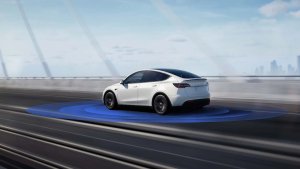
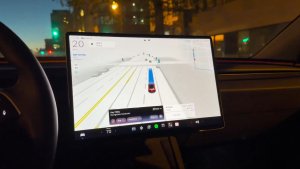
Similar to the Robotaxi gold path and underglow, when FSD is active, a new blue underglow now appears beneath the car in the on-screen visualization. While this underglow is subtle, it provides a way for the user to see that FSD is enabled, even when the vehicle isn’t moving and a blue path isn’t visible.
Increased Attention Required

Tesla has also added a new “Increased Attention Required” alert. When approaching potentially challenging zones like construction sites or railroad crossings, a new “Increased Attention Required” alert will appear on the screen, prompting the driver to pay closer attention as their vehicle navigates the obstacles ahead.
While the prompt doesn’t include an audible tone, we really love this attention. As FSD continues to improve, we tend to start believing it’ll handle every situation; however, the system knows when its confidence is lower, either due to challenging areas or environmental factors such as sun glare. Alerting the driver to pay closer attention in a low-confidence situation is a great addition.
When you engage FSD, your vehicle will now indicate that “FSD (Supervised) hands-free mode on”. This is a far more visual indicator than the usual green dot near the top corner of the display, telling users that the driver attention monitoring was active.
Start FSD from Park
Tesla has relabeled “Start FSD from Park” to “Start Self-Driving,” which makes a lot of sense. The button has also moved to a different location and is now available at any time during driving. We may see “Full Self-Driving” rebranded to something simpler, like Self Driving or “Tesla Self-Driving,” which Tesla has been using in some of its videos lately.
Hands-Free Mode

While Tesla removed the “steering wheel nag” in the summer of last year with FSD v12.4.2, they’re now officially naming the feature “Hands-free Mode.” While hands-free mode is available on most Tesla vehicles, including all Model 3, Model Y, Cybertruck, and 2021+ Model S and X, it’s not always available. Newer vehicles include an infrared light that helps illuminate the cabin at night; however, when the cabin camera can’t properly detect the driver, it’ll fall back on steering wheel torque to assess driver attention.
Instead of Tesla relying only on the green dot on the display to let users know that hands-free mode is active, Tesla will now display a message on the screen whenever the feature is turned on or off.
While the green dot works well and aligns with what phones do to let users know the device’s camera is in use, Tesla has relocated its location to the very top right corner of the screen. While its further from the driving, it’s now near the airbag icon.
If you spend too long looking at the screen or looking away, it will now indicate “FSD (Supervised) hands-free mode off”, along with the usual prompts to have hands on the steering wheel. Once it detects you’re paying attention again, it will re-engage just like normal.
How FSD Controls Speed
Turns out max speed was still too complicated so we deleted it altogether. The best part is no part.
— Phil Duan (@philduan) October 7, 2025
Speed profiles are much more responsive with v14. And if you really want to drive slow, try the new sloth profile. https://t.co/v4i7P7sbfc
Tesla has done another major revamp to how FSD handles speeds. FSD V14.1 completely overhauls how drivers control the vehicle’s speed. The speed offset setting, introduced with FSD V13, is now gone, along with the ability to easily change this speed using the right scroll wheel.
Instead, all speed logic is now governed exclusively by the Speed Profile. Instead of the Speed Profiles just controlling how aggressive the vehicle is or which lane it uses, they now also affect how fast or slow the vehicle travels relative to the speed limit.
The new Mad Max profile is even more assertive and fast than Hurry, while the new Sloth profile offers a more cautious style that more strictly adheres to speed limits.
For some time, Tesla has said that any user input while on FSD, such as tapping the accelerator or adjusting the speed with the scroll wheel, is a system failure that needs to be trained out. Now, they’re doubling down on this by simplifying the interface and removing direct control over the vehicle’s speed.
This is going to be a contentious change, as FSD often misreads speed signs, requiring the vehicle’s speed to be tuned up or down. In addition, for those who live in areas with stricter speed monitoring, Sloth may become their primary profile.
Scrolling up and down now cycles through driving profiles, while the previous left/right action to adjust profiles also remains. On newer vehicles without the gear stalk, the right scroll controls FSD; up or down changes the profile and affects speed, while pressing it in enables or disables Autopilot. On vehicles with stalks, it's a bit of a mixed bag: a push on the right scroll wheel turns on Grok or voice commands.
Parking at a Supercharger
FSD’s end-of-trip intelligence has seen a massive upgrade in confidence and contextual awareness. Tesla outlines the new Arrival Options as owners having the ability to control what the vehicle does once it reaches its destination. Drivers can choose between Curbside for a quick drop-off or having the vehicle park in a parking lot, street, driveway, or garage. However, there are a few things Tesla didn’t state.
If your destination is a Supercharger, you can have the vehicle back into a Supercharger stall when it arrives, all without user intervention. This is actually more impressive than it seems, as the vehicle needs to determine exactly which spots include a charger and then perform the standard Autopark routine.
Head-First Parking
FSD V14 is now also not limited to backing into spots. When the vehicle arrives at its destination, it will find a parking spot —either based on your selection or one it has deemed appropriate —and will now park head-first when appropriate.
Front Bumper Camera Usage
While Tesla has been slow to add a front-bumper camera to all of its vehicles, it has finally added it to the Model 3, which was the last vehicle without one. While FSD didn’t previously rely on this camera, with FSD V14, it’s now using it for the first time.
On vehicles with a front bumper camera, FSD V14.1 now officially uses it as a sensor input; if the camera is obstructed, the car will now display a warning, requesting the user to clean it.

No More Autopilot
In an interesting change that users should be aware of, Tesla appears to be all-in on FSD, or at least on the stack it relies on. Vehicles with FSD V14, the toggle to switch to Traffic-aware Cruise Control (TACC) or Autosteer no longer works, meaning that drivers either have to use FSD, or nothing at all.
There’s speculation that Tesla will be updating Autosteer and TACC to leverage the same stack that FSD relies on, making those features essentially a more limited version of FSD.
Earlier this year, Tesla announced that Autosteer would not be coming to the Cybertruck at all. The Cybertruck requires all-new training, and it appears Tesla has decided not to invest the time in creating the feature for the truck. Instead, they offered users one year free of FSD.
Update: Tesla restored TACC and Autopilot in later versions of FSD v14.
FSD V14 continues to roll out to the broader fleet in North America; however, it has not been made available in China, Australia, or New Zealand.