Tesla update 2025.32.3 includes an undocumented change to Tesla’s drowsiness detection feature. The change was discovered by Tesla hacker Green, who detected the change in decompiled Tesla code.
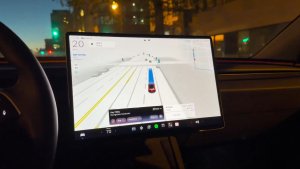
When your vehicle detects that the driver is drowsy or notices multiple lane departure assistance warnings, your vehicle will display a pop-up on the screen, prompting you to proactively engage FSD to help you keep an eye on the road.
The on-screen alert uses the same design as a previous prompt that reminds owners and subscribers of FSD to activate and use the feature.
From Passive Warning to Active Intervention
For years, advanced safety systems in vehicles have operated on a simple principle. Detect a problem, such as drifting from a lane, and alert the driver with a chime or vibration. The responsibility for correcting the issue remained entirely with the human driver.
While some manufacturers did offer driver assistance pull-over systems, they are far and few between, and mostly only operate on the highway, enabling the vehicle to pull over if the driver is unconscious.
Tesla is taking a different approach, and the new alerts in 2025.32.3 demonstrate just how they plan to do that. Drivers will see prompts such as:
“Lane drift detected. Let FSD assist so you can stay focused.”,
“Drowsiness detected. Stay focused with FSD.”
Addressing the Elephant in the Room
This relatively small change is interesting because of how Tesla is now recommending FSD. When you engage FSD, Tesla still tells you to keep your hands on the wheel and actively supervise. Now, when you’re unable to drive at your best, Tesla suggests you use FSD and supervise rather than drive.
At this point, FSD is getting close to what we always wanted it to be, software that can get you to your destination with minimal driver input. However, it’s not at the point of human-level safety yet, and the driver still needs to be attentive and take over at a second’s notice.
This new tip offers to take on the complex task of driving, the car can de-escalate a potentially dangerous situation far more effectively than a simple chime or vibration can. It’s a tangible first step towards a future where your Tesla will pre-emptively assist a driver who is impaired or distracted.
While it’s a step forward, the wording of the new prompts is interesting. Asking an already inattentive or incapable driver to supervise a system that requires attention is an interesting suggestion, and one that will have to be refined over time, especially as Tesla continues to push towards Unsupervised FSD.
However, this wrinkle in the design doesn’t detract from the importance of the underlying statement. The primary goal here is to make the driver and vehicle safer, and offering the use of FSD in combination with the driver’s attention should result in a safer ride for everyone involved.
The Future of Safety
Ultimately, this update is more than just a new alert; it’s a sign that Tesla is immensely confident in FSD’s ability to be a safer alternative when compared to a compromised human driver. While there are still some kinks to work out regarding supervision, FSD can be a real-time safety net for tired drivers.
Driving while tired can happen for any number of reasons, but if it prevents an accident, that’s a huge win. We’re sure Tesla’s ultimate goal is to have FSD take over if a driver is completely incapable, and given that some other manufacturers already offer this as an emergency intervention feature, we’re sure Tesla will do so sometime in the near future as well.