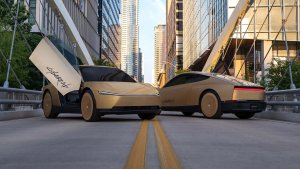
A Tesla Cybercab appears to have been involved in a crash in Philadelphia, and the damage offers a rare look inside the purpose-built robotaxi’s door. Tesla watcher @TeslaZoa shared the news on X, noting that it seems to have been “a relatively low-speed collision” that knocked off the Cybercab’s left door panel.
The exact circumstances of the incident haven’t been confirmed yet, including who was at fault. Philadelphia isn’t one of Tesla’s Robotaxi markets, so this Cybercab was likely out on validation testing.
A Rare Look Inside the Cybercab’s Door
Photos originally shared by a Reddit user show the gold Cybercab parked along a Philadelphia street with its outer door skin missing. That exposes the black inner frame, window regulator, latch hardware, wiring, and a crossbar running the length of the door to protect against side impacts. The window glass is still intact, while the side skirt below the door is crumpled and the rear quarter panel is scuffed.

The Cybercab’s body panels are made through an ultra-efficient reaction injection molding (RIM) process, with paint injected during molding instead of a traditional paint shop. Since the door panel is plastic, it likely popped off instead of denting. Tesla showed off plenty of Cybercab details at its launch event last month, but the inside of its doors wasn’t among them.
Built to Protect Passengers
Behind that panel is only part of the Cybercab’s safety story. The two-seater has 10 individual adaptive airbags. This includes front, knee, curtain, and unique seat-mounted side airbags on both the inner and outer sides of the seats, while a ceiling-mounted radar sensor detects whether a seat holds an adult, a child seat, or nothing at all to tailor airbag deployment. The doors also include a mechanical latch that works without electrical power, built right into the regular electronic door release button so passengers can get out even if the car loses power.

Cybercab and Robotaxi Safety Record
This isn’t the Cybercab’s first run-in. Earlier this spring, a Cybercab was rear-ended during validation testing in what was its first known public road incident.
Tesla’s commercial Robotaxi fleet has a mostly positive record so far. Between mid-April and mid-June, the fleet logged just one incident: a pickup truck rear-ending a Robotaxi stopped at a red light. Tesla’s unredacted crash reports showed that most of its 19 earlier incidents were minor, low-speed events caused by other drivers, with only two minor injuries.
As more Cybercabs hit public roads, minor collisions like this one are bound to happen. If Tesla or local reports share more details, we’ll learn whether this one was another case of a human driver at fault.